Theology & Life
Called to the Banquet of Eternal Life Mt 22:2-14
Author - Associate Professor Philip Kariatlis
There is a passage within the Gospel according to St Matthew (Mt 22:2-14), known as the ‘Parable of the Wedding Banquet’ [1] in which our Lord Jesus Christ talks about the Kingdom of Heaven. The great significance of this story lies in that our Lord Jesus Christ gives us a remarkable glimpse into the destiny for which every human person has been created; that is the joy of God’s eternal kingdom. The passage compares the Kingdom of Heaven to a wedding feast—a simple yet profoundly evocative analogy with which we can all relate. A wedding banquet awakens within us a sense of joy and delight; it is an occasion of celebration, communion and cheerfulness. We know from the passage that the king’s invitation is gracious, and yet, as the story unfolds, we will see, quite unexpectedly, that a considerable number of guests will refuse to come. And the question which quite justifiably arises is: if in fact God’s eternal Kingdom can be compared with such a joyous occasion of abundance and delight—one in which God desires nothing but to bestow the immeasurable gift of his divine love to all—why would anyone refuse such an invitation?
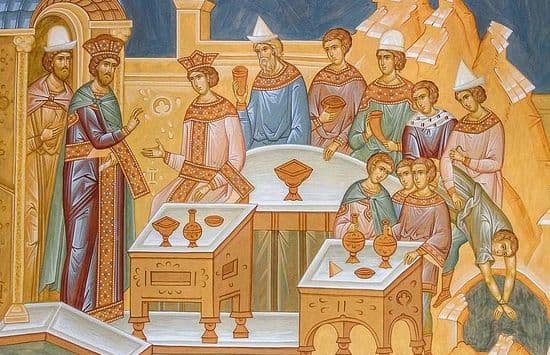
The force of this question becomes even clearer when we consider that the banquet described by Christ was no ordinary feast; it was one hosted by a benevolent king. Accordingly, one can only imagine its splendour. No expense would have been spared; the finest food would have been prepared, the halls would have been adorned with beauty, and everything arranged with abundance and generosity. We are told, in the Gospel reading, that the king had all things prepared: “Look, I have prepared my dinner, my oxen and my fat calves have been slaughtered, and everything is ready” (Mt 22: 4). Indeed, everything had been prepared to perfection! Already, this detail tells us something of God’s boundless love for us. The gift of his coming kingdom will be one characterised by sheer and inexhaustible abundance: all heavenly gifts will be bestowed to us out of God’s sheer love for the human person so that we may share, for all eternity, in his everlasting blessedness and beatitude.
In today’s context, God’s messengers may not be physically cast into pits or put to death. Yet their message and proclamation can be—and indeed often are—met with something more subtle: simpl indifference. So many of us today are totally absorbed in the immediate concerns of life that we lose sight of those things that are of ultimate importance and permanent value. In this way we remain deaf to the Church’s enduring message of salvation. Our lives can become crowded with endless distractions—not necessarily evil in themselves, but remarkably trivial when viewed against the horizon of eternity. We can fill every waking moment with activity: acquiring possessions, seeking constant entertainment, pursuing professional ambition and social recognition, preoccupied with financial security, consumed by social media, endless information and countless other concerns. The danger arises when these temporary realities assume greater importance in our lives than those eternal truths which alone can give our existence its ultimate meaning. And herein lies something deeply tragic: we pursue finite things in the hope that they will provide an enduring fulfilment they simply cannot give. Our longing for joy is real, profound and deeply human. Yet we can become extraordinarily busy without ever stopping to ask where our life is actually going—or, more fundamentally, what our life is ultimately for. We can expend enormous energy acquiring things that one day we must leave behind; we can fill our lives with countless possessions and experiences and yet remain strangely empty. So often, we seek lasting fulfilment in realities that, by their very nature, cannot last. We look to temporary things to satisfy a longing within the human heart that ultimately reaches beyond this world and into eternity.
And all the while the invitation of God continues to sound: “Everything is ready; come to the wedding banquet.” Notwithstanding all that God had prepared for all his guests at the banquet, God’s love is such that it never abolishes the freedom of the human person. God’s invitation remains open, yet love, if it is truly love, never compels. We remain entirely free to either enter into the joy of the Lord, or mysteriously, if not tragically, to turn away from the eternal banquet prepared for us. The tragedy, therefore, is not that God has failed to invite us. Rather, the tragedy is that we have become so preoccupied with lesser things that we no longer recognise the immeasurable gift being offered to us. Yet human indifference does not exhaust God’s generosity. When the first guests refuse to come, the king sends out his servants again: “Go therefore into the main streets and invite everyone you find to the wedding banquet” (Mt 22:9). And here we are given an insight of the breathtaking and striking universality of God’s love. Everyone is invited! Not simply the righteous, the morally upright and respectable. Not only those who possess theological knowledge or can articulate the doctrines of the faith. The servants gather, Christ tells us, “all whom they found, both good and bad” (Mt 22:10). Such is the extraordinary love of God for the human person. Before we have made ourselves worthy, before we have put our lives in order, before we have achieved anything at all, God calls us.
Yet the Gospel does not end there; there is one final and sobering scene. After everyone had been invited, the king, we are told, entered the banquet and noticed that one of his guests was not wearing a wedding garment. And he asks him: “Friend, how did you get in here without a wedding robe?” (Mt 22:12). The meaning here is profound. God’s love and generosity do not mean that our response is irrelevant. This guest had been invited; he had been given the requisite garment to wear and yet he refused. This shows that, as Christians, we cannot say that we follow Christ while remaining entirely indifferent to the way that Christ has called us to live. It is not enough merely to call ourselves Christians without striving to ‘clothe ourselves’ with Christ: with his love, with his humility, his mercy and forgiveness, to name a few. Reflecting a little further, we are reminded that it is not enough simply to attend Church, to read the Scriptures or spiritual books, or even to possess extensive knowledge about God. We are called to allow what we believe to transform who we are becoming. Christ Himself says: “Those who have my commandments and keep them are those who love me” (Jn 14:21). Yet even here we must be careful. For the opposite error is also possible: we may begin to imagine that because we keep the commandments, God somehow owes us eternal life. This of course is a mistaken view.
The garment in the Gospel reading signifies a life that is striving to align itself with Christ. If Christ is truly our treasure, then this must somehow become visible in the way we live: in our willingness to forgive; in our concern for the person who suffers; in our refusal to condemn; in our generosity towards those in need; in our struggle against selfishness; in our willingness to look beyond ourselves and see the person whom God has placed before us. For if we truly desire to live eternally with Christ, then, surely, we must begin learning to live with Christ now. Accordingly, in reflecting on the Gospel reading, we too must answer the question: What are we doing with the invitation? Christ, the King has invited us. The banquet has been prepared. The doors have been opened. Everything is ready. Are we allowing the temporary concerns of this life to make us indifferent to the eternal? Are we so preoccupied with what will inevitably pass away that we have forgotten the One who alone does not pass away? Or are we already beginning, however imperfectly, to prepare ourselves for the joy to which we have been called?
Christianity ultimately proclaims something astonishing: that beyond the suffering, incompleteness and mortality of this present existence, there awaits not emptiness, but a banquet; unfading joy and fulfilment in God’s eternal kingdom; a life illumined and suffused by the radiant presence of Christ; a life, ultimately, without end. The invitation has already been sent. And if we freely respond to that invitation—if we allow ourselves to be clothed in the garment of Christ, striving in this life to love Him and one another—then there awaits us that Kingdom in which, as the Church so beautifully prays, “the sound of those who keep festival is unceasing, and the delight is endless of those who behold the ineffable beauty of Your countenance. For You, Christ our God, are the One who is truly desired, and the inexpressible gladness of those who love You.” May we never exchange that invitation for things that pass away. May we never become so distracted by this life that we miss the reason for which life itself was given to us. And may we hear, while there is still time, the loving summons of the King: “Everything is ready; come to the wedding banquet.”
[1] A closely related parable can also be found in Luke 14:15-24, known in this case as parable of the Great Banquet.
About The Authors
![Associate Professor Philip Kariatlis [Faculty & Staff > Sub-Dean]](/_next/image?url=https%3A%2F%2Fimages.ctfassets.net%2Fgaf4nq7icj7m%2F2nXIBGMsV4DAw4M8a0rU2%2F442690adeed7d589266c127d16969212%2FFrame_15602__1_.webp&w=1920&q=75)
Sub-Dean
Associate Professor Philip Kariatlis
Associate Professor Philip Kariatlis is Sub-Dean and Associate Professor of Theology at St Andrew’s. After taking an undergraduate degree in Theology from St Andrew’s (Sydney College of Divinity), he graduated from the University of Sydney with a degree in Arts, majoring in Modern Greek. He received a Master of Theology and a doctorate from the Sydney College of Divinity, where he studied under Pr...