Theology & Life
Reaching Towards Christ: Faith, Healing, and Hope: the Raising of Jairus’ Daughter and the Healing of a Woman (Lk 8:41-56)
The Gospel reading recounting our Lord’s raising of Jairus’ daughter and His healing of a woman who had suffered from a serious ailment for many years offers a profound and deeply consoling insight into the transformative power of faith. Faith, understood not simply as intellectual assent to certain truths about God, but above all as a living and ever-deepening relationship of trust in Him, is indeed an extraordinary power. As we shall see, it enables us to look beyond the limitations of what we can see, comprehend, or explain, opening our hearts instead to the boundless love and life-giving presence of God. Such faith invites us to entrust ourselves wholeheartedly to Christ’s loving providence, even in those moments when all human hope appears to have been exhausted. Indeed, even in the face of death itself, faith opens before us boundless horizons of hope, assuring us that neither suffering nor death has the final word over human existence.
For the person of faith, no matter the circumstances, the final word belongs but to Christ Himself, who is our life and resurrection, and in whose life-giving presence even the power of death is overcome. It is precisely this extraordinary power of faith—its capacity to sustain and awaken trust amid uncertainty, and to open our lives to the transforming presence of our loving God—that the Church places before us for reflection in this Gospel reading. Indeed, it does so, wishing each of us consider the great power of faith on a most personal and intimate level. The Church invites us to consider: Do we have faith in Christ? Do we trust Him? More broadly, perhaps, do we trust those around us? Do we have confidence in institutions and communities that exist to assist us? Do we trust the Church of Christ? Or, have we made ourselves the criterion of truth? For at the heart of genuine faith lies profound humility. We are further reminded that faith, in this sense, does not in any way diminish our freedom or understanding, but opens us to a deeper way of knowing and living, one grounded not in the illusion of our own self-sufficiency, but in the loving presence of Christ.
The Evangelist Luke brings together the two encounters of a young girl and an ailing woman that reveal this extraordinary power of faith. The raising of Jairus’ daughter and the healing of the woman who had suffered from a haemorrhage for twelve years reveal the extraordinary reality into which faith invites us: a new way of living, transformed by the life-giving presence of Christ and sustained by the boundless love and hope that flow from communion with Him. Although their circumstances differ, we are told in the Gospel that both Jairus and the suffering woman approach Christ with an urgent need but also, and most importantly, a trusting heart. Through their encounters with Christ, we too are invited to discover what it means to believe. Jairus was a leader of the synagogue, a man who held a recognised position of responsibility within the Jewish community. Yet, when he approached Jesus, his public standing could offer him little consolation. His twelve-year-old daughter was dying. He stood above all before Christ as a father pleading for the life of his child. He knelt before Christ humbling himself and beseeching Him to heal his dying daughter.
One can only scarcely imagine the anguish behind his appeal. All his hopes, all his love, and all his fears were gathered into this single request: that Jesus would agreed to come to his home and save his daughter. At that very moment, however, while Jesus was still speaking, someone arrived with the devastating news that the child had died. Jairus was told that there was no longer any reason to trouble the Teacher. From a human perspective, everything was over. And yet, it is precisely at this very moment, when all hope appeared to have vanished, that Christ said to him: “Do not fear. Only believe, and she will be saved [μὴ φοβοῦ, μόνον πίστευσον, καὶ σωθήσεται]” (Luke 8:50). These words did not necessarily dismiss the father’s grief. Rather, they invited him to entrust that grief to the One whose authority extended even beyond death. Indeed, what is incredible is that even in the face of the heartbreaking reality of his daughter’s death, he remains steadfast in his faith! He believes in the deepest depths of his heart that Jesus can and will do something.
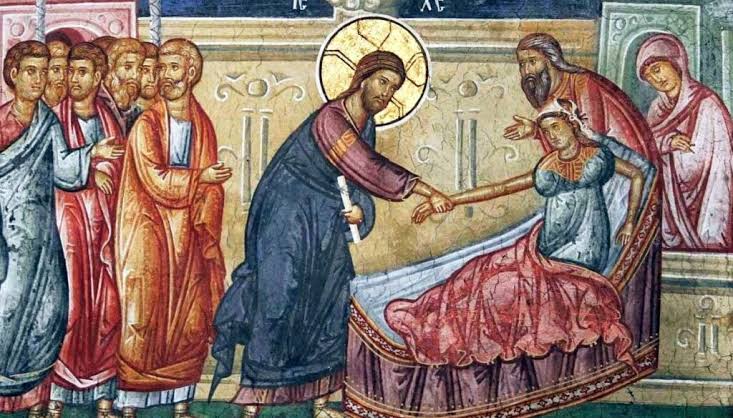
The Gospel story continues revealing that when Jesus entered the house, He found people weeping, wailing and mourning. He said to them: “Do not weep; for she is not dead but sleeping [μὴ κλαίετε, οὐ γὰρ ἀπέθανεν ἀλλὰ καθεύδει]” (Luke 8:52). Those present ridiculed and laughed at Jesus, knowing that the child had died. Yet Christ’s words brought to light something they could not yet comprehend: before the Lord of life, the Physician of our souls and bodies, death itself would surrender its power. Taking the girl by the hand, Jesus called to her: “Child, get up!” (Luke 8:54). Her spirit returned, and she rose immediately. He then instructed that she be given something to eat—a tender and practical expression of His care for the child that He had restored to life. The source of this miracle was of course Christ Himself. Jairus’s faith, on the other hand, was made tangible in his willingness to remain open to Christ, even when every outward circumstance seemed to contradict the possibility of hope. He was called to look beyond the limitations of his own understanding and to entrust himself wholeheartedly to the One for whom even death is not an insurmountable barrier.
Sensing that “power had gone out of Him” (Luke 8:46), Jesus asked who had touched Him. The disciples were puzzled: a large crowd was pressing around Him from every direction. Yet there was a difference between being physically close to Jesus and reaching towards Him in faith. When the woman realised that she could not remain unnoticed, she came forward trembling and declared what had happened. Christ addressed her with words of extraordinary tenderness: “Daughter, your faith has made you well; go in peace” (Luke 8:48). “Daughter.” With this one word, He acknowledged her dignity and belonging. The woman who had approached Him in fear was received with love. Her healing became a public affirmation that she was seen, valued, and welcomed.
These two miracles beautifully illuminate one another. Both wish to bring to light the transformative power of faith. A father fears the loss of his daughter; a suffering woman hears herself addressed as “Daughter.” One child has lived for twelve years; one woman has suffered for twelve years. Into both lives, Christ brings His healing presence, revealing a love that attends personally to each human being. What, then, does this Gospel teach us about faith? Faith is not simply the acceptance of certain truths about God, but above all a living relationship of trust in Jesus Christ. It is a willingness on our part to entrust ourselves to Him, to place our lives into His loving hands, and to lean upon His presence when we cannot see a way forward. It allows us to say: “Lord, I cannot understand everything that is happening; I do not know what tomorrow will bring, but I entrust myself to Your love.”
In times of illness, bereavement, financial hardship, or uncertainty, we may feel that our strength has reached its limit and that the burdens of life have become almost too difficult to bear. Yet it is precisely in such moments that the Gospel invites us to turn towards Christ, bringing before Him our fears, our struggles, and even our deepest weaknesses, trusting that His grace can sustain us. This grace becomes manifest in so many ways: through the loving care of those around us, through prayer and the sacramental life of the Church, and through the quiet courage to persevere, even when the path ahead remains uncertain. Indeed, the Christian life is inseparably shaped by the mystery of the Cross and Resurrection, reminding us that suffering and death do not have the final word over our existence. Christ Himself has entered into the very depths of human suffering and death, transforming them through His life-giving presence.
And it is precisely for this reason that suffering need never become a place of utter abandonment or despair. Faith invites us to remain steadfast in our trust in Christ, to persevere even when all seems hopeless, knowing that beyond the Cross lies the promise of the Resurrection. As our Lord Himself assures us, “The one who endures to the end will be saved” (Mt 24:13). And again, in the Book of Revelation, we hear His profoundly consoling promise: “Be faithful until death, and I will give you the crown of life” (Rev 2:10). These words remind us that faith is not merely a momentary expression of belief, but a lifelong journey of trust and perseverance, sustained by the conviction that, whatever trials we may encounter, the love of Christ will never abandon us, and the promise of His eternal life remains our ultimate hope.
At every Divine Liturgy, the Church calls us: “Let us stand well [Στῶμεν καλῶς]” This is not simply an invitation to stand attentively and reverently before God, but also to place our entire lives into His loving hands, with all our joys and sorrows, our hopes and fears, our strengths and weaknesses. It is an invitation to entrust ourselves wholeheartedly to the One whose love never fails us. And perhaps this is precisely the message that we are called to carry away from τηεGospel reading: to allow Christ᾽s words to Jairus, “Do not fear. Only believe” (Lk 8:50), to become a guiding principle in our own lives. When fear and uncertainty overwhelm us, let us remember these words. When our strength falters and hope seems distant, let us reach out towards Christ, just as the suffering woman reached out to touch the hem of His garment. For the same Lord who tenderly took Jairus᾽ daughter by the hand and lovingly addressed the suffering woman as “Daughter” knows each of us personally, sees our struggles, and invites us into the embrace of His life-giving love. May we, therefore, learn to entrust ourselves ever more deeply to His loving providence, to support one another with compassion through life᾽s many trials, and to live with the unwavering hope that, in Christ, neither suffering nor death has the final word. The final word belongs to life, to love, and to the promise of the Resurrection.
About The Authors

Sub-Dean
Associate Professor Philip Kariatlis
Associate Professor Philip Kariatlis is Sub-Dean and Associate Professor of Theology at St Andrew’s. After taking an undergraduate degree in Theology from St Andrew’s (Sydney College of Divinity), he graduated from the University of Sydney with a degree in Arts, majoring in Modern Greek. He received a Master of Theology and a doctorate from the Sydney College of Divinity, where he studied under Pr...