Theology & Life
The Healing and Restoring Love of Christ: the Gerasene Demoniac (Luke 8:26–39)
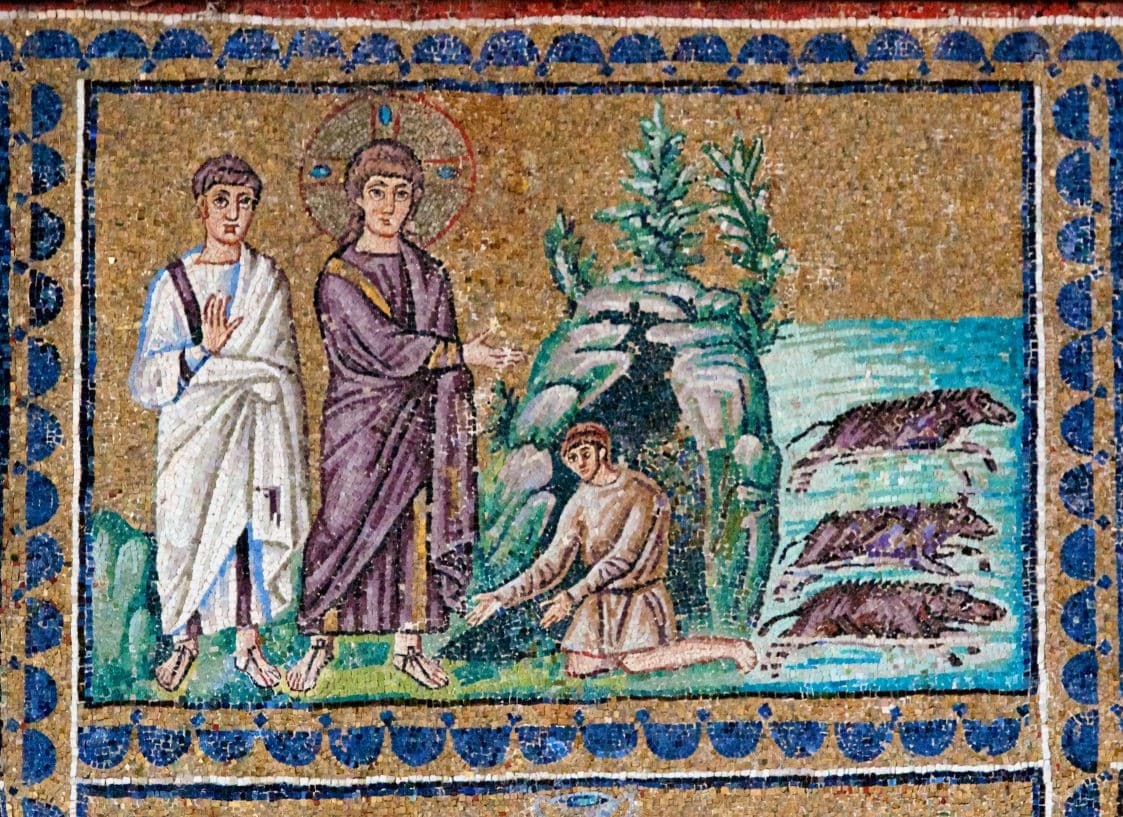
In the Gospel reading assigned for the sixth Sunday of Luke, we encounter yet another profound manifestation of this divine love and compassion. St Luke the Evangelist recounts the healing of a man who, for many years, had been tormented by an entire legion of demons. Once again, Christ reveals Himself as the true Physician of our souls and bodies, as the Lover of humankind, who desires nothing other than to heal humanity’s wounded condition and restore to us all the joy, grace and peace that come from communion with God. St Luke describes the man’s tragic condition with striking vividness. Deprived of freedom and dignity, he wandered naked among the tombs, driven into desolate places, separated from his family and community. Yet, it is precisely into this darkness in which Christ enters, who, with divine authority and boundless compassion, liberates this possessed man from the powers that had enslaved him. Already, we see here that Christ searches out and extends his compassionate and loving ‘hand’ to all those in need in order to raise them out of the seeming impasse of their tragic plight.
The transformation that results from this encounter is extraordinary. The Gospel notes that the man who had once wandered restlessly among the tombs is now found “clothed and in his right mind [ἱματισμένον καὶ σωφρονοῦντα]” (Lk 8:35). The one who had previously been enslaved is now free; the one who had lived in isolation is now restored to communion with others. From this remarkable encounter, there are least two important lessons which emerge and to which our attention is now turned.
The Tragedy of a Life Estranged from God
The first concerns the tragic condition of the human person—indeed, every human person— who, when enslaved by forces that diminish their freedom and estrange them from God, becomes increasingly alienated from the fullness of joy and life for which they were created. Although the demoniac’s affliction is extraordinary, his condition also invites us to reflect, in a broader spiritual sense, upon the ways in which we ourselves can become enslaved by destructive passions and habits that gradually gain mastery over us, diminishing our freedom and leaving us imprisoned by their power. Indeed, how often do we discover that certain tendencies within us have acquired greater power over our lives than we ourselves exercise over them. With striking clarity, St Isaac the Syrian (7
th
cent.) specifically warns of the enslavement that arises when we allow our pursuit of worldly pleasures to gain mastery over us gradually diminishing our freedom and estranging us from God. He writes: “Do not bind your freedom with what affords you pleasure, lest you become a slave of slaves.”[1] Pride, greed, anger, envy and excessive self-love can gradually imprison the human heart. Their consequences become painfully evident in bitterness, resentment, fractured relationships and an increasing inability to forgive or love generously.Such is the tragedy of a life estranged from God: what initially promises freedom and satisfaction can ultimately lead to isolation and inner emptiness. Yet the Gospel reveals something infinitely more important: no degree of human brokenness lies beyond the healing and restoring love of Christ. Indeed, what is particularly moving is the way Christ actively seeks us out, precisely in the depths of our emptiness, not to condemn us, but to liberate us and restore us to the fullness of life. Just as He restored the Gerasene demoniac to freedom and wholeness, so too does Christ invite us to draw upon His inexhaustible love, allowing His grace to transform our hearts. Indeed, shortly before His Passion, Christ assured His disciples: “Abide in my love” (Jn 15:9), adding, “These things I have spoken to you, that my joy may be in you, and that your joy may be complete” (Jn 15:11). These words are profoundly consoling: Christ does not invite us merely into a life of religious obligations, but into the freedom and joy of communion with Him. His commandments illuminate the way towards the fullness of life for which we were created: to enjoy for all eternity His radiant and glorious Presence.
The Unsettling Response of the Gerasenes
A second lesson which arises from the Gospel reading is the astonishing response of the inhabitants of the surrounding region. Having witnessed the restoration of their suffering neighbour, one might reasonably have expected them to rejoice and approach Christ with gratitude. Yet the very opposite occurs. St Luke tells us that, overcome with fear, they “asked Him to depart from them [καὶ ἠρώτησαν αὐτὸν… ἀπελθεῖν ἀπ’ αὐτῶν]” (Lk 8:37). There is something profoundly tragic about their response. Before them stood the Lord of life, who had just restored a suffering human being to freedom and dignity. Yet rather than welcoming Christ with gratitude and joy, they asked Him to leave. Their reaction reveals something profoundly troubling about the human condition: we can become so attached to the familiar securities of our lives that we resist even the transforming presence of God Himself.
And herein lies a question of enduring relevance for each of us. Do we truly desire Christ to dwell within our lives? Or do we sometimes allow our ambitions, attachments and personal interests to take precedence over Him? We may profess our love for Christ, yet through our choices and priorities effectively ask Him to remain at a distance. It is precisely for this reason that Christ elsewhere declares: “Seek first the Kingdom of God and His righteousness, and all these things shall be added to you” (Mt 6:33). These words do not call us to abandon our responsibilities, but to discover their proper meaning by placing Christ at the centre of our lives. So often, we pursue security, comfort, success and recognition, forgetting that none of these can ultimately satisfy the deepest longing of the human heart. For we were created for something infinitely greater: communion with the living God, whose love alone bestows upon our existence its ultimate meaning and fulfilment.
So often, we expend our energies pursuing things we believe will bring us lasting happiness—in the case of the Gerasenes, it was their material prosperity—only to discover that they leave us unfulfilled. Although our Lord is the source of infinite joy and delight, we continue to turn to finite realities, expecting them to satisfy a longing that ultimately transcends all that this world can offer. Perhaps the response of the Gerasenes provide us with the opportunity to ask ourselves, not ‘what more can I amass to become happier’ but rather ‘what kind of life can truly satisfy a human heart whose deepest longing reaches beyond everything temporary?’ The Psalmist provides the answer: “You show the path of life. In your presence there is fullness of joy; in your right hand are pleasures forevermore”—ἐγνώρισάς μοι ὁδοὺς ζωῆς· πληρώσεις με εὐφροσύνης μετὰ τοῦ προσώπου σου, τερπνότητες ἐν τῇ δεξιᾷ σου εἰς τέλος. (Ps 16:11). Ultimately, it is only in the loving presence of our Lord Jesus Christ that the deepest yearnings of the human heart find its fulfilment.
Yet a further distinction, albeit briefly, deserves our attention: it is not simply the peace, joy or consolation that Christ bestows upon us that we are called to seek, however precious these gifts may be, but Christ Himself, whom we are invited to love for His own sake, with an undivided heart. The saints consistently remind us that our desire must be directed towards Christ rather than the consolations that may accompany His presence. Indeed, an excessive preoccupation with such experiences can subtly turn our attention away from God and towards ourselves, leading us to delight more in our perceived spiritual attainments than in the One who is the source of every blessing. St Diadochos of Photiki (5
th
cent.), for example, warns of precisely this danger when he speaks of the intellect becoming “unreservedly proud of its own experience of spiritual perception,”[2] thereby rendering itself vulnerable to spiritual deception (πλάνη). To put it simply, by way of example: we do not pray primarily to experience the peace or joy that prayer may bring, however precious these gifts may be. Rather, we pray out of love for Christ Himself, seeking to enter more deeply into communion with Him and to dwell in His loving presence. Ultimately, we were created not merely to enjoy the gifts of this world, or even the spiritual consolations of God's grace, but to enter into loving communion with the One from whom every good gift proceeds and in whom alone our joy finds its true and everlasting fulfilment.The Gospel reading, therefore, reminds us to strive each day to place Christ first in our thoughts, in our choices and relationships, allowing His grace to transform our lives. Like the Psalmist, our prayer ought also to be: “One thing I asked of the Lord, that will I seek after: to live in the house of the Lord all the days of my life, to behold the beauty of the Lord [μίαν ἠτησάμην παρὰ Κυρίου, ταύτην ἐκζητήσω· τοῦ κατοικεῖν με ἐν οἴκῳ Κυρίου πάσας τὰς ἡμέρας τῆς ζωῆς μου, τοῦ θεωρεῖν με τὴν τερπνότητα τοῦ Κυρίου]” (Ps 27:4). May we express the same longing as that of St Paul: “I want to know Christ and the power of his resurrection and the sharing of his sufferings [τοῦ γνῶναι αὐτὸν καὶ τὴν δύναμιν τῆς ἀναστάσεως αὐτοῦ καὶ κοινωνίαν παθημάτων αὐτοῦ]” (Phil 3:10). Let us strive to remember that the fullness of human life is not discovered in the accumulation of what we possess, but in the depth of our communion with the One who is Himself the source of all life. Indeed, as we strive to turn towards Christ, we begin to allow His love to restore within us the joy, freedom and peace of His eternal Kingdom; we allow our heart to receive Christ Himself so that He might come and abide in us forever!
[1] Ascetical Writings, Homily 4.
[2] On Spiritual Knowledge, 33.
About The Authors

Sub-Dean
Associate Professor Philip Kariatlis
Associate Professor Philip Kariatlis is Sub-Dean and Associate Professor of Theology at St Andrew’s. After taking an undergraduate degree in Theology from St Andrew’s (Sydney College of Divinity), he graduated from the University of Sydney with a degree in Arts, majoring in Modern Greek. He received a Master of Theology and a doctorate from the Sydney College of Divinity, where he studied under Pr...