Theology & Life
The Parable of the Rich Fool: the Wealth That Truly Endures: Becoming Rich Towards God
In addressing these questions, the Gospel reading is a most timely reminder that material possessions, worldly achievements, and fleeting pleasures, however desirable, are ultimately transient and cannot accompany us beyond the threshold of death. By contrast, the treasures born of the Spirit—love, joy, peace, kindness, generosity, and compassion—all rooted in our communion with God, bear within them the promise of eternity.Herein lies the profound and uplifting message of the Lukan passage: that true richness of life is measured not by what we accumulate for ourselves, but by the extent to which our hearts are transformed by divine love—a love which, through Christ’s death and Resurrection, has conquered death itself and opened before us the fullness of eternal life. It is precisely in opening our hearts to this divine love, and allowing it to find expression in our loving care for those around us, that we discover our true spiritual ‘passport’ to heaven—namely, our entrance into that joyous and liberating reality of God’s eternal Kingdom, where love knows no end and life is brought to its everlasting fulfilment.
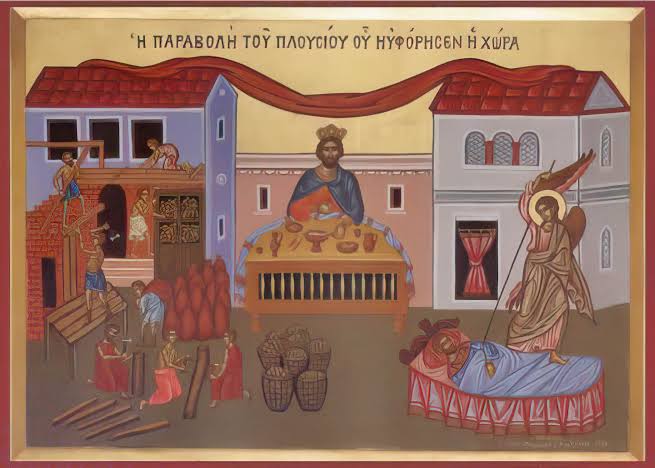
At first glance, the man described in the Gospel passage appears to be remarkably successful according to worldly standards. We are told that his land had produced an abundant harvest. Indeed, so plentiful was his yield that his existing barns were no longer sufficient to accommodate it. We might reasonably imagine that he had worked diligently, managed his affairs prudently, and demonstrated considerable initiative and resourcefulness. In contemporary terms, we might describe him as an accomplished businessman, an industrious entrepreneur, or a capable steward of his possessions. Perhaps, the abundance of his harvest could rightly have been understood by him as a blessing from God, an occasion for profound gratitude and thanksgiving. And yet, this was not the case. It is precisely here that his foolishness comes to light and why his conduct merits such a severe judgement.
It is important to recognise here that the rich man is not condemned simply because he possesses wealth. The Gospel does not suggest that material prosperity is inherently sinful, nor does it diminish the importance of honest work, responsible provision for one’s family, or the prudent management of one’s resources. Indeed, all these can constitute expressions of faithful Christian stewardship. Rather, the tragedy of the rich man lies in something far more profound: he has allowed his possessions to become the very centre of his existence, confusing the accumulation of wealth with the fullness of life, and material prosperity with the genuine security that can ultimately only be found in God. Focused almost entirely on his material well-being, he failed to nurture and cultivate “the one thing needful” (Lk 10:42), that human longing which reaches beyond the finite. Having lost sight of God as the true source and sustainer of all life—the One in whom our hearts find lasting satisfaction—and having placed all confidence in himself, he mistakenly imagines that his future can be secured through material means alone. The consequence is a restless and insatiable greed for ever more, which gradually imprisons him within the narrow confines of his own self-interest, leaving little room for gratitude towards God or loving concern for his fellow human beings. Accordingly, the relentless amassing of goods at all cost, without taking time to look beyond the self is, in the words of Christ, foolishness.
The first spiritual danger, therefore, revealed in the Lukan Gospel reading is that of greed—πλεονεξία—in Greek: namely, the unrelenting desire to acquire more and more, accompanied by an ever-deepening dissatisfaction with what one already possesses. One might reasonably have expected that, upon witnessing the extraordinary abundance of his harvest, the rich man would have been filled with joy and gratitude. Surely, his first response should have been one of heartfelt thanksgiving: ‘Glory be to God for all things’ [Δόξᾳ τῷ Θεῷ πάντων ἔνεκεν]! However, this is not what we encounter in the parable. Instead, he is depicted as becoming increasingly anxious, worrying about how he might preserve it all for himself. The rich man asks: “What should I do, for I have no place to store my crops?” (Lk 12:17). Having distanced himself from God, and seeking instead to find reassurance in his material possessions, the rich man’s wealth gradually takes possession of his heart and becomes the source of ever-increasing anxiety. It is precisely here that we find one of the profound spiritual insights of the Gospel passage: greed promises security yet breeds anxiety, leaving the human heart ever more impoverished, restless and dissatisfied.
Moreover, the Gospel passage reminds us that the person who becomes consumed by the relentless pursuit of material possessions, seeking in their accumulation a sense of security and fulfilment, inevitably discovers that the more they acquire, the more they desire. Each new possession gives rise to yet another ambition, perpetuating an insatiable cycle in which the promise of contentment remains ever elusive. Far from bringing the security and happiness so earnestly sought, this restless pursuit gradually deprives the human person of the capacity to rejoice in what they already having, enslaving the heart and drawing it ever more deeply into the narrow confines of self-interest. It is precisely against this spiritual danger that St Isaac the Syrian offers the following profound warning: “Do not bind your freedom by what affords you pleasure, lest you become a slave of slaves.” [1] These words capture the paradox at the heart of the rich man’s predicament: in seeking to possess ever more, he has allowed himself to become possessed by the very things he has accumulated. It is in this sense that greed, even while promising a fuller life, almost inevitably leads to a form of spiritual captivity—a kind of spiritual death, long before physical death itself. Simply put, even though he sought to protect himself from death, his affluence was, in all actuality, the cause of it.
Yet we must be careful not to misunderstand the Gospel’s message. There is nothing inherently sinful about providing for the necessities of daily life, securing a home, caring responsibly for one’s family, or making prudent provision for the future. These are natural and necessary dimensions of human existence and, when approached with gratitude and discernment, can themselves become expressions of faithful stewardship. In one of his homilies on social justice, St Basil the Great (4
th
cent.) writes with remarkable insight: “If you want storehouses, you have them in the stomachs of the poor.” [2] His words bring to light a fundamental truth which lies at the very heart of the Christian Gospel: not only learning to be content with what we have but also generously sharing our abundance with those in need. The spiritual danger therefore arises when the pursuit of material well-being so dominates our existence that little, if any, room remains for gratitude towards God, generosity towards others, or the cultivation of prayer and love. The tragedy of the rich man, therefore, is not simply that he possesses so much, but that, despite all he possesses, not only nothing can ever satisfy him, but he is not free to rejoice in all that he has. His example reminds us that true freedom and fulfilment are found not in the endless accumulation of possessions, but in learning to receive life’s blessings with thanksgiving and to share them generously in love.One can only imagine how different the rich man’s life might have been had he responded to his abundance with an openness and generosity to others, rather than anxious-filled self-interest. Grateful that he had all that he needed, he could have turned his attention towards those who had so little, recognising in his extraordinary harvest an opportunity to enrich not only his own life but also the lives of others. By sharing his abundance with the hungry, supporting families in difficulty, and contributing to the well-being of his wider community, he might have experienced a happiness far deeper and more enduring than anything material possessions could ever provide. Indeed, in giving freely of his resources, his time, and his care, he would not have become poorer in any meaningful sense. On the contrary, he would have discovered a wealth far greater than anything his barns could ever contain: the inestimable joy of a heart enlarged by love, liberated from the tyranny of self-interest, and drawn ever more deeply into communion with God, the inexhaustible source of all life, love, and joy.
The parable is a timely reminder that the Christian understanding of life is fundamentally relational. We are not created simply to exist alongside one another, still less to live exclusively for ourselves. We are created for communion: communion with God and communion with our fellow human beings. The Gospel brings to light that no amount of material prosperity can satisfy the deepest longing of the human heart—a longing not simply for comfort or pleasure, but for love, communion, and a life which transcends the limitations of this present world. The more our hearts become enclosed within the narrow boundaries of self-interest, the more we diminish our capacity to experience the fullness of life—“a life in all abundance” (cf. Jn 10:10)—for which we were created. Conversely, the more we open ourselves in gratitude to God and in loving concern for others, the more we begin to discover what it means to be truly human. The important lesson of the Gospel is that no matter how many finite things we may acquire in this life, they will never satisfy the infinite longing we all have for those enduring riches so graciously bestowed upon all by God, a life liberated from death itself and one of endless joy in beholding for all eternity the “indescribable beauty of God’s countenance.” [3]
The foolishness of the rich man lies in his belief that his material possessions will give him lasting joy. Having completed his plans for larger barns and a comfortable future, the rich man reassures himself that he now possesses sufficient resources for many years of enjoyment. He says to himself: “Soul, you have ample goods laid up for many years; relax, eat, drink, be merry” (Lk 12:19). He imagines that his wealth has secured for him a long and carefree existence. The parable, however, takes a dramatic and unexpected turn. At precisely this moment, God addresses him with the sobering words: “You fool! This very night your life is being demanded of you. And the things you have prepared, whose will they be?” (Lk 12:20). With these words, the entire illusion upon which the rich man has constructed his entire life is exposed. He had planned for many years yet had forgotten that he could not guarantee even another day. The rich man’s mistake was to imagine that material wealth could provide an ultimate security which, by its very nature, it is incapable of giving. The Gospel reading invites us to examine our own lives and ask ourselves how often, perhaps, we seek lasting happiness and fulfilment in the very things that are themselves fleeting and cannot endure.
Indeed, the Church reminds us of this profound truth in the moving hymns of the Funeral Service, one of which declares: “Wealth does not endure, nor does glory accompany us.” Everything we accumulate in this world—our possessions, achievements, honours, and worldly distinctions—must one day be left behind. Yet what endures beyond the threshold of death is the love with which we have lived—namely, the generosity with which we have shared God’s blessings with others. For these acts of love, born of our communion with God, possess an eternal significance that neither the passing of time nor death itself could ever extinguish. It is precisely for this reason, that the Gospel passage provides an important opportunity to re-think our priorities. Striving for richness in God is what alone has permanence, indeed eternal permanence. In this way, the true measure of a person’s life is not the abundance of what has been accumulated, but the abundance of love that has been shared. For it is precisely through such love that our hearts are opened to the boundless love of God, in whose presence we are invited to share in the inexhaustible joy and beauty of eternal life.
Ultimately, Christ offers this parable not simply as a warning against greed or the misuse of wealth. It is an invitation to rediscover the true purpose of our existence. We have not been created merely to acquire, accumulate, and consume. Indeed, the adverse effects of such a consumerist mindset can be seen in today’s ecological crisis. We have been created to love and to be loved; to live in communion with God and with one another and more broadly, with nature; and, through this communion, to participate in the fullness of life which Christ Himself has come to bestow upon the world. And herein lies the final and most beautiful truth of the Gospel passage. The rich man believed that his possessions could protect him from the uncertainty of life. Yet they could not protect him from death. Christ, however, reveals to us a treasure which death itself cannot destroy: the gift of divine love.
We must never lose sight of the extraordinary significance and impact of what Christ, our true and only Treasure accomplished on the Cross: out of his unfathomable love for humanity, the King and Lord of all willingly and voluntarily submitted to death in the flesh and in this way raised all humanity out from corruption, abolished the dominion of death, and opened the gates of eternity thereby offering the world the priceless treasure of salvation. And it is precisely this inexplicable love, grounded in the risen Christ, which overcomes death and opens before us the inexhaustible joy and priceless treasure of eternal life.
[1] St Isaac the Syrian, The Ascetical Homilies of Saint Isaac the Syrian, trans. Holy Transfiguration Monastery (Boston, MA: Holy Transfiguration Monastery, 1984), Homily 4, p. 31.
[2] Basil the Great, I Will Tear Down My Barns, Homily 6, 6, in On Social Justice, trans. C. Paul Schroeder (Crestwood, NY: St Vladimir’s Seminary Press, 2009), 68.
[3] Cf. First Prayer of Thanksgiving after receiving Holy Communion.
About The Authors

Sub-Dean
Associate Professor Philip Kariatlis
Associate Professor Philip Kariatlis is Sub-Dean and Associate Professor of Theology at St Andrew’s. After taking an undergraduate degree in Theology from St Andrew’s (Sydney College of Divinity), he graduated from the University of Sydney with a degree in Arts, majoring in Modern Greek. He received a Master of Theology and a doctorate from the Sydney College of Divinity, where he studied under Pr...