Theology & Life
Sunday Before the Exaltation of the Holy Cross
Associate Professor Philip Kariatlis
The Gospel reading prescribed for the Sunday before the Exaltation of the Precious and Life-Giving Cross (Jn 3:13–17) brings us to the very heart of the Christian mystery. Indeed, it provides the key by which we can begin to comprehend what St Paul calls “the breadth and length and height and depth” of the love of Christ (Eph. 3:18). The Cross reveals the profound mystery of divine love: indeed, a love so immeasurable that it emerged more powerful than death itself! Through the Cross, God’s pre-eternal plan for humanity was brought to its fulfilment so that the human race might share, for all eternity, in the unfading blessedness and beatitude of divine life in God’s eternal kingdom. Once an instrument of torture and humiliation, a symbol of suffering and death, through Christ the Cross has become—and indeed continues to be—the expression par excellence of God’s boundless love for the world and the supreme sign of His saving work. For upon the Cross, our Lord Jesus Christ gave Himself entirely for the life of the world. Descending into the depths of Hades, He struck it dead by the “flash of His divinity,” thereby opening for humanity the way to eternal life. In this way, the Cross stands at the very centre of the Christian faith, revealing, once and for all, the unfathomable extent of God’s love for the world and the glorious destiny for which humanity was created: eternal life in His Kingdom and unending communion with Him.
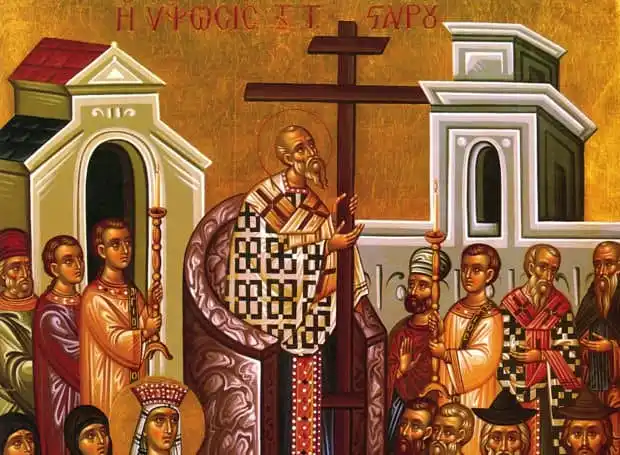
Specifically, in the Gospel reading, Christ is portrayed speaking with Nicodemus and, quite remarkably, foretelling His own crucifixion: “As Moses lifted up the serpent in the wilderness, so must the Son of Man be lifted up, that whoever believes in Him may have eternal life” (Jn 3:14–15). In so doing, Christ takes Nicodemus back to a mysterious event recorded in the Old Testament Scriptures, within the Book of Numbers. Already Christ’s reference to Moses reveals the continuity between the Old and New Testaments. When the Israelites were afflicted by poisonous serpents in the wilderness, God had instructed Moses to raise up a bronze serpent. Those who looked upon it in faith would be healed and would live (Num. 21:4–9). The Fathers of the Church saw in this event a foreshadowing of the mystery of the Cross. Just as the serpent was lifted up in the wilderness and became an instrument of healing, so too would the Son of Man be “lifted up” upon the Cross so that humanity, wounded by sin and held captive by death, might receive the gift of life in all abundance. Whilst what was given to Israel in the wilderness was a temporary sign of healing, in Christ, the Cross became the source not merely of healing from physical death, but of eternal life for the whole world.
Yet the Cross reveals something far greater than deliverance from death. It reveals who God essentially is. At the centre of Gospel passage stands perhaps the best-known words of the entire New Testament: “For God so loved the world that He gave His only-begotten Son, that whoever believes in Him should not perish but have eternal life” (Jn 3:16). These words reveal the deepest meaning of the Cross. Whilst the Cross is certainly the place of forgiveness and reconciliation, it is, even more profoundly, the supreme revelation of divine love: the manifestation of a God whose love for His creation is so boundless and inexhaustible that He gives Himself entirely so that the world might have life in Him. In this regard, St Isaac the Syrian (7th cent.) writes profoundly and with remarkable insight:
The entire purpose of our Lord’s death was not to redeem us from sins, or for any other reason, but solely in order that the world might become aware of the love which God has for creation. Had all this astounding affair taken place solely for the purpose of the forgiveness of sins, it would have been sufficient to redeem us by some other means. [1]
For St Isaac, then, the Cross is not simply God’s response to human sin; it is the ultimate disclosure of the very heart of a loving God, whose love for His creation is so boundless that He gives Himself completely in order to draw humanity into the joy of eternal communion with Him.
In highlighting the centrality of the Cross, it follows that the Christian life does not begin with what we may wish to offer to God, but with what God has first offered us. And the mystery of the Cross reveals that what He offers is nothing less than Himself. In this way, our life in Christ does not begin with our search for God, but with God’s movement towards us culminating in his loving sacrifice to bestow upon the world the gift of “life in all abundance” (Jn 10:10). It is a love which gives itself completely, descending into the depths of human suffering; entering even into death itself in order that death might no longer have the final word over the human person. The Cross therefore stands as a living testimony and symbol of death’s destruction. Indeed, as the pre-eternal Son and Word of God, death has no hold over Him; quite the opposite, it is destroyed. On the Cross, Christ entered death destroying it from within. He descended into the darkness of the grave and filled even that darkness with His divinely radiant and resplendent presence. The instrument of execution therefore becomes the instrument of salvation. This remarkable paradox is captured beautifully in the hymn of the Church: “Your Cross, O Lord, is life and resurrection for Your people; and trusting in it, we praise You, our crucified God. Have mercy on us.” And so, at the very place where death appeared to triumph, the boundless love of God transformed death into life. Accordingly, the grave of Christ became the gateway of resurrection and the enduring sign of humanity’s victory in Christ.
Indeed, in celebrating the Cross and Resurrection every Sunday, the Church proclaims: “Behold, through the Cross joy has come into all the world.” This is one of the great paradoxes of Christianity. The Cross and joy are not mutually exclusive, nor is Christian joy to be understood in terms of the absence of suffering. Rather, the gift of unfading joy is precisely the discovery that suffering, sacrifice and even death itself cannot separate us from the love of God. Quite the contrary, when we turn to Christ, especially amid life’s most difficult moments, we discover a joy so profound and enduring that nothing in this world can take it away. In Christ, even those realities which appear to diminish life now become pathways into a deeper and more enduring life. For this reason, the Church calls the Cross “the guardian of the whole world,” “the beauty of the Church,” “the support of the faithful” and “the gate of Paradise.” The Cross opens again the path towards communion with God, revealing that humanity’s ultimate destiny is not death, but life; indeed, communion and participation in the eternal Kingdom of God. In this way, the faithful are invited to entrust themselves to the love of God as revealed most perfectly on the Cross and to allow it to become the pattern of life of their own. Ultimately, to believe in the crucified Christ, therefore, means, in some measure, to learn to live cruciform lives. And this is perhaps where the Gospel becomes most demanding.
As Christians, we readily venerate the Cross; it is often worn around our necks; it is readily placed in our homes. Indeed, we make its sign upon ourselves. All of these are precious expressions of our faith. But the Cross of Christ ultimately asks something more of us: namely, a way of life. Our Lord explicitly states: “If any want to become my followers, let them deny themselves and take up their cross and follow me” (Mt 16:24). The Cross, therefore, becomes real within us whenever we choose self-effacing love over self-interest; whenever we strive to relinquish our need always to be right; whenever we refuse, for example, to retaliate against someone who has wounded us. Moreover, the power of the Cross becomes a reality in our lives whenever we forgive even though resentment might have been easier; whenever we choose to give without calculating what we will receive in return. In this way, the Cross is a gift but also an invitation to choose the way of Christ: not retaliating when someone hurts us; not vindicating ourselves when we might have been misunderstood. Such sacrifices can appear to us as losses. Yet the mystery of the Cross teaches us something astonishing: what is given in love is never ultimately lost. Christ surrendered His life—and His self-offering became the life of the world.
This does not mean that Christians should tolerate injustice passively, nor that genuine wrongdoing should simply be ignored. Rather, it means that evil must never be allowed to determine the manner in which we ourselves live. The Christian response to hatred, for example cannot be hatred; nor can bitterness give rise to greater bitterness. The radical freedom offered by Christ on the Cross is that there is another possibility: namely, to respond with goodness and forgiveness, with generosity and compassion. This is what it means for the Cross to become life within us. This is precisely what St Paul encourages when writing to the faithful in Ephesus. He prays that “Christ may dwell in your hearts through faith, as you are being rooted and grounded in love… so that you may be filled with the fullness of God” (Eph 3:17 & 19). As St Paul reveals, when we begin to live in this way, something remarkable happens. The love revealed upon the Cross gradually begins to take root within the human heart. The heart becomes softer, freer and more spacious, and the fullness of Christ’s own love begins to dwell within us.
The mystery of divine love revealed on the Cross helps us to better understand the words which follow within the Gospel passage: “God did not send His Son into the world to condemn the world, but in order that the world might be saved through Him” (Jn 3:17). This is an extraordinarily hopeful statement. Christ does not come into the world searching for reasons to condemn humanity; rather, He comes to save it. His entire incarnate life—from Bethlehem to Golgotha, from womb to tomb—is the manifestation of this one inexhaustible divine desire: that the human person might live. In this way, it is important to remember that even the Christian teaching concerning judgement must therefore be understood within this mystery of divine love. Quoting St Isaac the Syrian again who categorically writes: “Among all God’s actions there is none which is not entirely a matter of mercy, love and compassion: this constitutes the beginning and end of His dealings with us.” [2] And elsewhere he beautifully notes:
Just as a grain of sand will not balance in the scales against a great weight of gold, such too is the case with God’s justice when it is weighed against His compassion. When compared with God’s mind, the sins of all flesh are like a handful of sand thrown in the sea. [3]
For St Isaac, the One before whom we will ultimately stand is none other than the One who stretched out His hands upon the Cross for us. Divine judgement cannot, therefore, be separated from divine love.
The question posed for us then, is whether we are willing now to open ourselves to that love: whether we will allow the cruciform love of Christ to shape our relationships with all those around us—even those whom we find difficult to love. It is profoundly significant that near the beginning of the new ecclesiastical year, the Church places the Cross before our eyes. It is as though the Church wishes to remind us, at the very outset of another year, what must stand at the centre of the Christian life. The Church invites the faithful to place the Cross front and centre of their lives; to allow it to become their strength, their hope and, in the words of St Paul, their “boast”: “May I never boast of anything except the cross of our Lord Jesus Christ” (Gal. 6:14). But to boast in the Cross means more than to honour it externally. It means allowing its mystery to penetrate the whole of our existence. The Cross must move beyond being an ornament that we wear around our neck and begin to take its permanent place within the heart. It must move beyond being a mere a symbol that we wear, to a life we live. It remains for us to enter into its mystery; not merely to venerate it, but to allow it to shape the way we live. For it is this path that leads to the joy of life in all its fulness.
[1] St Isaac the Syrian, The Second Part, ch. 3.IV.78.
[2] St Isaac the Syrian, The Second Part 39.22.
[3] St Isaac the Syrian, Homily 50.
About The Authors
![Associate Professor Philip Kariatlis [Faculty & Staff > Sub-Dean]](/_next/image?url=https%3A%2F%2Fimages.ctfassets.net%2Fgaf4nq7icj7m%2F2nXIBGMsV4DAw4M8a0rU2%2F442690adeed7d589266c127d16969212%2FFrame_15602__1_.webp&w=1920&q=75)
Sub-Dean
Associate Professor Philip Kariatlis
Associate Professor Philip Kariatlis is Sub-Dean and Associate Professor of Theology at St Andrew’s. After taking an undergraduate degree in Theology from St Andrew’s (Sydney College of Divinity), he graduated from the University of Sydney with a degree in Arts, majoring in Modern Greek. He received a Master of Theology and a doctorate from the Sydney College of Divinity, where he studied under Pr...