- Home
- About us
- Students
- Courses
- Research
- Library
- News & Events
- Gallery
- Contact
- Our Blog
Latest News

INTRODUCTION TO NEW TESTAMENT GREEK
A7120A
Unit Weighting
9 cps
Type of Unit
Foundational
Prerequisites
None
Academic Staff
Mr Anastasios Kalogerakis, BBus (Monash, 1996), BTh (SCD, 2000), MTh (SCD, 2010), Teacher
Curriculum Objectives
This course unit introduces the student to the elements of New Testament Greek and enables the student to begin to develop professional skills in New Testament exegesis and translation.
Learning Outcomes
At the end of this unit students will be able to:
- demonstrate familiarity with basic Grammar and Syntax of New Testament Greek
- memorize basic Greek vocabulary
- translate selected texts into English
- use dictionaries and concordances
- apply the knowledge of New Testament Greek to translating the New Testament
Content
- Greek alphabet, basics of Greek grammar and syntax
- Textual, lexical, and grammatical study of selected New Testament texts
- Translation of selected New Testament texts
- Introduction to working with Greek/English dictionaries, and concordances
Assessment Profile
- Regular tests on vocabulary, grammar and translation (ranging from 10 to 25 mins). Value: 20%
- Regular homework on grammar and translation. Value: 20%
- End of semester examination (90 mins). Value: 60%
Prescribed Texts
Machen, John Gresham. New Testament Greek for Beginners. Upper Saddle River, New Jersey: Prentice-Hall, 1923.
Lee, John A.L. Greek Accents in Eight Lessons. Sydney: Ancient History Documentary Research Centre, Macquarie University, 2005.
Schedule
3hr lecture per week on campus, or via distance education.

Enrolments Now Open!
.jpg)
Study at St Andrew's

Subject Areas on Offer
Gallery
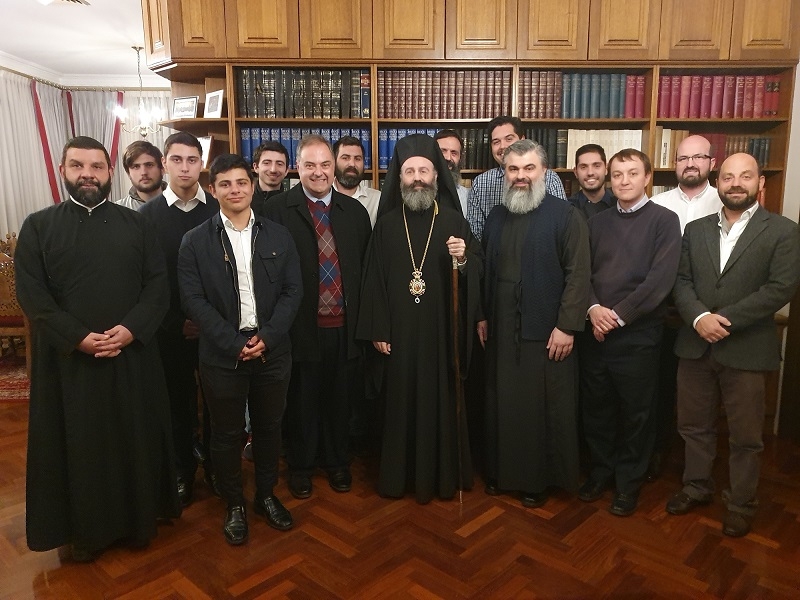
The Library

The library was established with the opening of St Andrew's in... see more
Subscribe to our Blog!
Subscribe to our blog written by our Faculty and learn more about your Orthodox Christian faith
Connect With Us
|
|
|
|
Join Our |


.png)
Copyright © 2019 St Andrew's Greek Orthodox Theological College.
All Rights Reserved. | Website Terms & Conditions