- Home
- About us
- Students
- Courses
- Research
- Library
- News & Events
- Gallery
- Contact
- Our Blog
Latest News

NEW TESTAMENT GREEK
A8570A
Unit Weighting
9 cps
Type of Unit
Foundational
Prerequisites
A8520A
Academic Staff
Dr Gregory Fox, BA Hons (Sydney 1963) DipEd (Sydney 1964) HonDD (Fiji 2005), Associate Teacher
Curriculum Objectives
This course unit builds on A8520A Introduction to New Testament Greek. It consolidates and develops students’ knowledge of New Testament Greek and their ability to translate.
Learning Outcomes
At the end of this unit students will be able to:
- demonstrate thorough knowledge of advanced morphological and syntactic forms
- display well-developed knowledge of a substantial Greek vocabulary
- confidently translate complex New Testament Greek texts into English, making competent and appropriate use of dictionaries, reference grammars, etc.
- exhibit a well-developed ability to carry out textual criticism
- apply an understanding of New Testament Greek to interpretation of the New Testament
Content
- Further study of Greek grammar and syntax
- Textual, lexical, and grammatical study of selected New Testament texts
- Translation of selected New Testament texts
- Further practice in consulting Greek/English lexicons, and theological dictionaries
Assessment Profile
- Demonstrate knowledge of New Testament Greek vocabulary and grammar (regular in-class quizzes and final exam)
- Demonstrate competence in translation and analysis of selected texts (regular home assignments)
Prescribed Texts
Machen, John Gresham. New Testament Greek for Beginners. Upper Saddle River, New Jersey: Prentice-Hall, 1923.
Lee, John A.L. Greek Accents in Eight Lessons. Sydney: Ancient History Documentary Research Centre, Macquarie University, 2005.
Schedule
3hr lecture per week on campus, or via distance education

Enrolments Now Open!
.jpg)
Study at St Andrew's

Subject Areas on Offer
Gallery
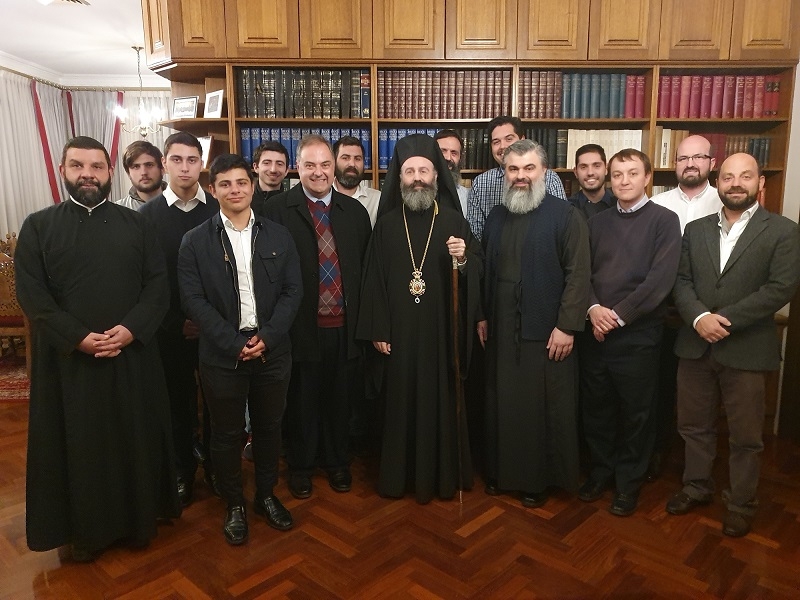
The Library

The library was established with the opening of St Andrew's in... see more
Subscribe to our Blog!
Subscribe to our blog written by our Faculty and learn more about your Orthodox Christian faith
Connect With Us
|
|
|
|
Join Our |


.png)
Copyright © 2019 St Andrew's Greek Orthodox Theological College.
All Rights Reserved. | Website Terms & Conditions