- Home
- About us
- Students
- Courses
- Research
- Library
- News & Events
- Gallery
- Contact
- Our Blog
Latest News

T8534A The Triune God and Revelation
This graduate unit builds on the knowledge and skills learned in the introductory unit in theology. It prepares the student for more specialised study at higher levels through a study of the nature, attributes and creative work of the Triune God as this is made known to us through his self-revelation.
| Unit Code: | T8534A | |
| Unit Name: | The Triune God and Revelation | |
| Credit Value: | 9 credit points | |
| Mode of Study: | Face to Face/ Synchronous ZOOM and Asynchronous. | |
| Pre-Requisite Units: | 9 TH cr pts at 8500-level |

Background
In today's society, the word, ‘dogma’ is seen in a very pejorative way. Indeed, dogmas are usually considered by most to be fixed, unbending rules created by human persons in authority throughout history. Furthermore, for many people dogmas constitute a ‘great scandal’ of Christianity, or at any rate a bold demand on the faithful. More particularly, this is precisely how theological truths pertaining to God and God’s self-revelation to the world are seen. Living in an age which ‘demythologises’ all institutions and structures, doctrinal truths not only seem inappropriate but also provocative and unbecoming with regards to the dignity of the emancipated human person. For this reason, they are in constant need of new justification. This course unit aims at uncovering the attitude of the early Church towards doctrinal truths in order to examine the extent to which these precepts, according to the Psalmist, “… are right, rejoicing the heart… and lightning the eyes… more to be desired a day than gold, even much fine gold; sweeter also than honey, and drippings of the honeycomb.” (Ps 19:7-10).
Learning Outcomes
At the end of this unit, students will be able to:
• Demonstrate a broad and coherent understanding of the literature and the major theological doctrines (Revelation, Trinity, God the Father, Creation, Providence) relevant to this unit; • Identify and explain the doctrinal presuppositions that are the foundation for Theology;
• Demonstrate a critical awareness of the ways that the Church has understood the interaction between the self-revealing God and creation;
• Analyse a range of primary and secondary literature dealing with God’s self-revelation and his interaction with creation;
• Critically evaluate key issues arising from their study of God’s self-revelation in the light of our contemporary cultural and religious setting;
• Transfer this knowledge to pastoral situations arising within their ministry setting.
Weekly Topics
- Introduction and Requirements to the Course Unit
- Towards a definition of Orthodox dogmatic theology – comparison with other definitions. Its character, methodology, object, content and sources. Doctrinal outline.
- Orthodox dogmatic theology: A historical overview; Personalities and literature.
- Doctrine of God. The Life [Ζωή] and Presence [Παρουσία] of God; indications of his personal Presence through his energies
- The ‘traditional attributes of God, their source and theological validity or weight. The Trinitarian God
- Origins, development and complexities of the Trinitarian doctrine; the mystery par excellence of unity in diversity [God in Himself; God for us; God in the world].
- Foreshadowings or Veiled Signs of the Trinity: The Old Testament Witness of God; The New Testament Witness to God
- The Greek Patristic traditions, especially that of the Cappadocians in the formulation of the Trinitarian doctrine; Theological Synthesis: Persons – Essence – Energies.
- Anthropological and ecclesiological implications of the Trinitarian doctrine. The Trinitarian foundations of reality.
- Creation of the World ex nihilo; the world’s sacredness
- Creation and the Ecological Crisis
- Revision and Concluding Remarks.

Enrolments Now Open!
.jpg)
Study at St Andrew's

Subject Areas on Offer
Gallery
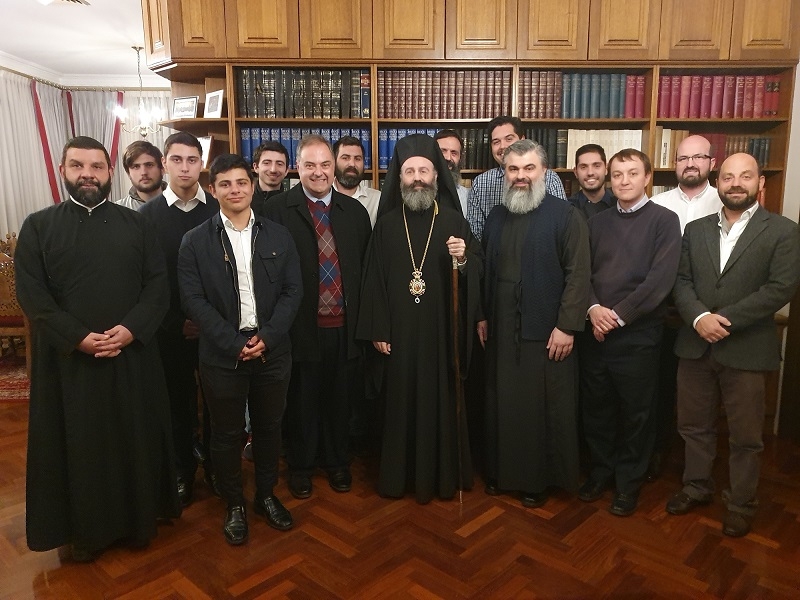
The Library

The library was established with the opening of St Andrew's in... see more
Subscribe to our Blog!
Subscribe to our blog written by our Faculty and learn more about your Orthodox Christian faith
Connect With Us
|
|
|
|
Join Our |


.png)
Copyright © 2019 St Andrew's Greek Orthodox Theological College.
All Rights Reserved. | Website Terms & Conditions