- Home
- About us
- Students
- Courses
- Research
- Library
- News & Events
- Gallery
- Contact
- Our Blog
Latest News

T7291A The Nicene Creed
The undergraduate course unit examines the major doctrines found in the fourth century ‘Nicene Creed’ with a view to demonstrating the slow emergence of what came to be defined as pro-Nicene orthodoxy. In so doing students will have been immersed deeply in those doctrines which lie at the very heart of the Christian faith and been exposed to the perennial power latent in that ancient text.
| Unit Code: | T7291A | |
| Unit Name: | The Nicene Creed | |
| Credit Value: | 9 credit points | |
| Mode of Study: | Face to Face/ Synchronous ZOOM and Asynchronous. | |
| Pre-Requisite Units: | T7101A Introduction to Theology |

Background
The Nicene Creed holds a place of profound importance within the life of the Church, not only for its theological precision in affirming the divinity, unity, and particularity of Christ in relation to God the Father—proclaiming Him as "true God from true God, begotten not made, of one essence with the Father"—but also as a unifying symbol and authoritative summary of the Christian faith. It emerged from the First Ecumenical Council at Nicaea (325 AD) as a response to heretical distortions, particularly Arianism, and was later expanded at the Council of Constantinople (381 AD), thereby securing the Church’s commitment to the full truth of the Trinity. Beyond its doctrinal clarity, the Creed serves as a shared confession that transcends time and geography, uniting believers across the ages and throughout the world in a common proclamation of faith. Recited in the Divine Liturgy and in personal prayer, it continues to shape the Church’s theological consciousness and liturgical identity, safeguarding the integrity of the apostolic teaching and offering a concise yet rich expression of the mystery of salvation.
Learning Outcomes
At the end of this unit, students will be able to:
• display a broad understanding of the development of the NiceneConstantinopolitan Creed;
• demonstrate sound knowledge of pro-Nicene theology
• evaluate recent scholarly literature on Nicene orthodoxy
• Critically analyse the major doctrines formulated in the Creed within the broader historico-theological phenomenon of the time
• assess the relevance of the creed to contemporary Christian
Weekly Topics
- The Nicene Creed as a Summary, Statement Symbol and Standard of Faith
- The Nicene Faith—Knowing Christ
- Christ and Creation
- Christ and the Father
- Christ and the Trinity
- Christ and Salvation
- Christ and the Church
- Christ and Death and the Age to Come

Enrolments Now Open!
.jpg)
Study at St Andrew's

Subject Areas on Offer
Gallery
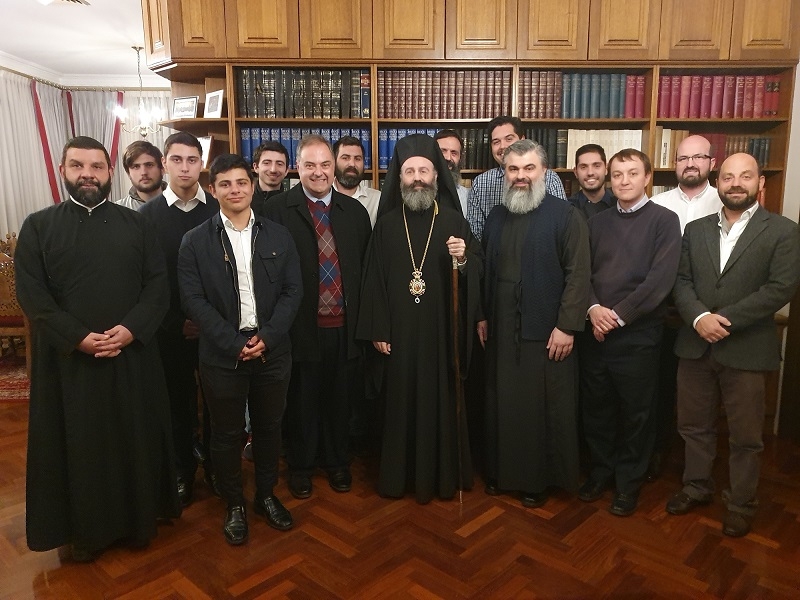
The Library

The library was established with the opening of St Andrew's in... see more
Subscribe to our Blog!
Subscribe to our blog written by our Faculty and learn more about your Orthodox Christian faith
Connect With Us
|
|
|
|
Join Our |


.png)
Copyright © 2019 St Andrew's Greek Orthodox Theological College.
All Rights Reserved. | Website Terms & Conditions