- Home
- About us
- Students
- Courses
- Research
- Library
- News & Events
- Gallery
- Contact
- Our Blog
Latest News

Launch of a New Master of Greek Philosophy Program
Dec 29, 2025
admin
Launch of a New Master of Greek Philosophy Program
Launch of a New Master of Greek Philosophy Program
Commencing 2026
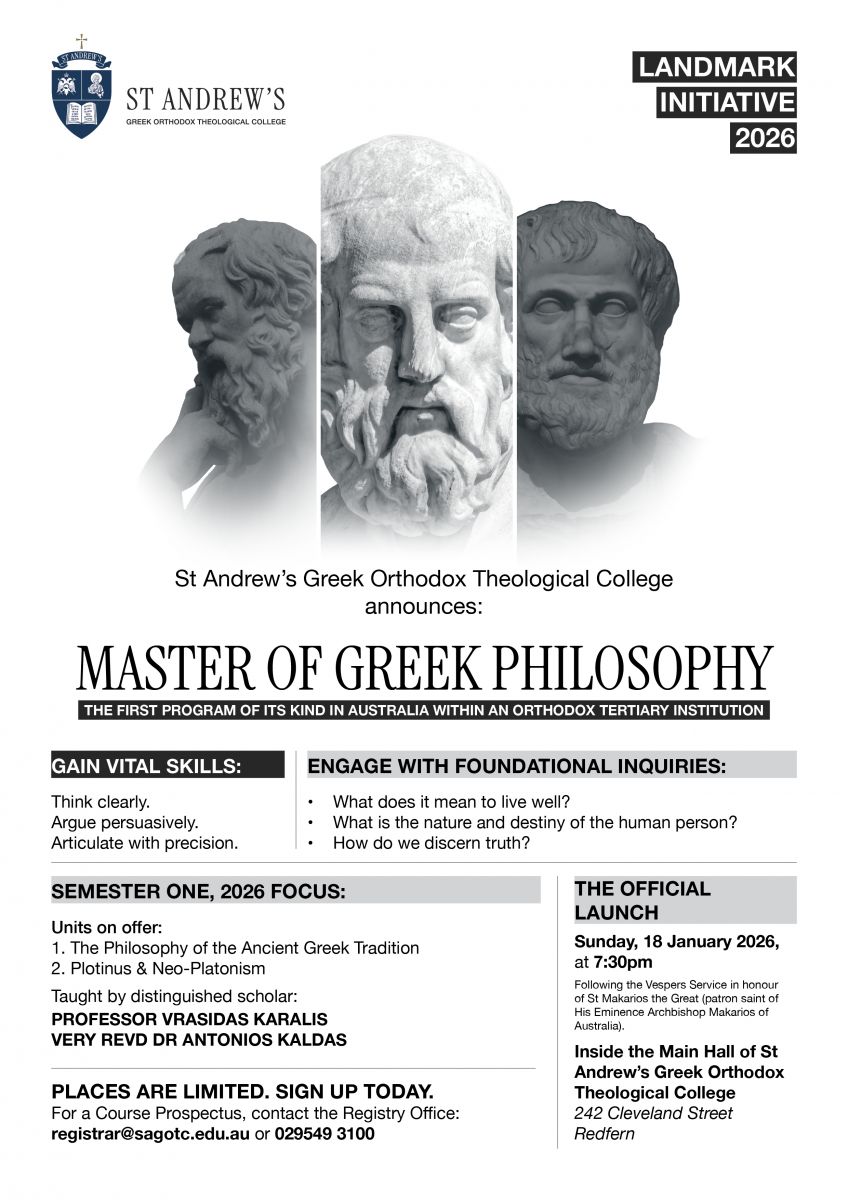
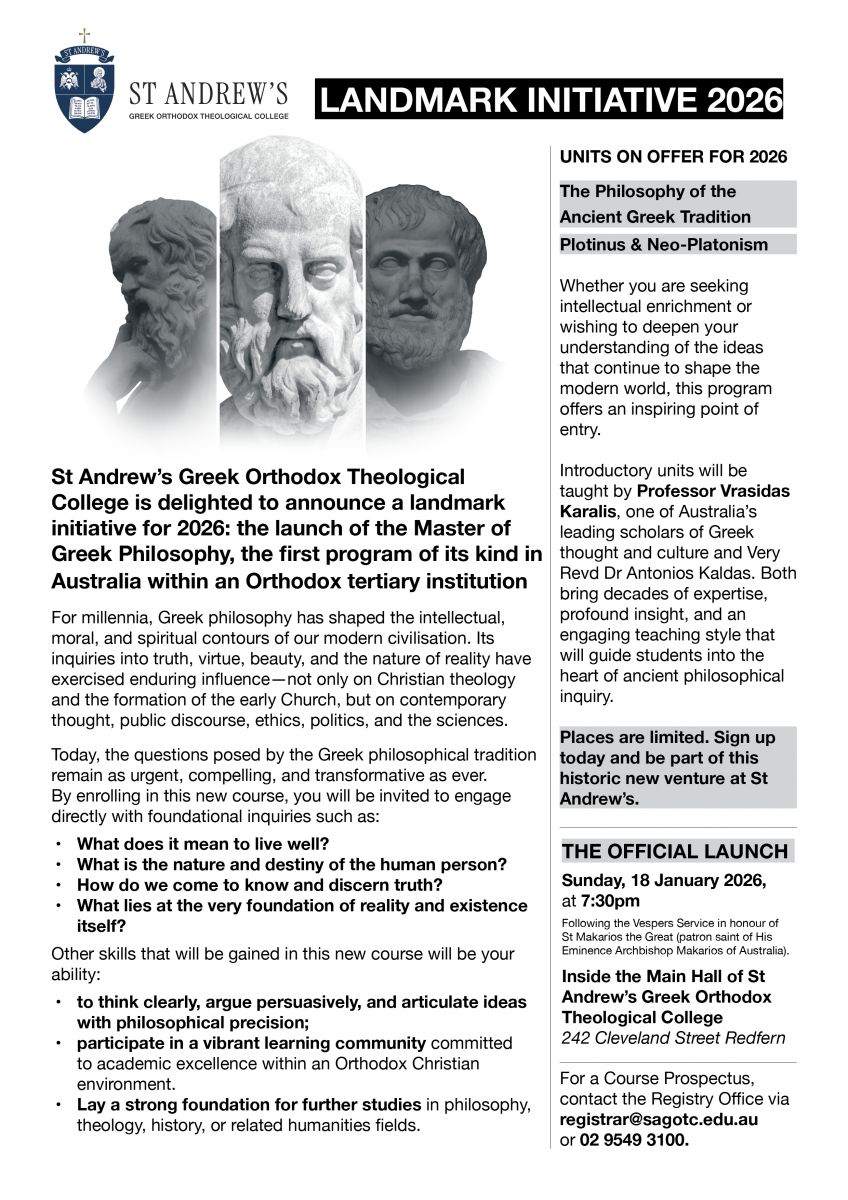
It is with great joy and satisfaction that St Andrew’s Greek Orthodox Theological College announces a landmark academic initiative: the introduction of a new postgraduate program, the Master of Greek Philosophy, to commence in the 2026 Academic Year. This is a historic development for both the Theological College and the broader academic landscape of Australia, highlighting the enduring contribution of Greek philosophical thought to theology, culture, and the formation of the human person.
The official launch of the Master of Greek Philosophy will take place on Sunday, 18 January 2026, at 7:30pm, in the Hall of St Andrew’s Greek Orthodox Theological College (242 Cleveland Street Redfern), following the Vespers Service in honour of St Makarios the Great (patron saint of His Eminence Archbishop Makarios of Australia), which will be celebrated earlier that evening at the Cathedral of the Annunciation of the Theotokos in Redfern. This celebratory occasion will mark an important milestone in the academic and spiritual mission of the College.
For millennia, Greek philosophy has shaped the intellectual and spiritual foundations of Western civilisation, posing the deep questions that continue to animate contemporary discussions about truth, ethics, metaphysics, human identity, and the nature of reality. The Orthodox Christian tradition, as a genuine heir to the Greek intellectual heritage, has long recognised the essential role of philosophy in supporting the articulation and development of theological reflection.
Two foundational units will be offered in Semester 1, 2026:
1. The Philosophy of the Ancient Greek Tradition
This unit offers a comprehensive introduction to Ancient Greek philosophy, beginning with the Pre-Socratics and culminating in the Hellenistic schools. Students will explore the emergence of key questions regarding being and becoming, the nature of knowledge, the soul, ethics, and the cosmos—questions that continue to shape philosophical inquiry today.
2. Plotinus and the Legacy of Neoplatonism
This unit will explore the thought of Plotinus and the Neoplatonic tradition, including figures such as Porphyry, Proclus, and Iamblichus and its profound influence in the early centuries of Christianity. Attention will be given to key themes such as the nature of reality, the relationship between the material and immaterial, the soul and the body, the problem of evil, and the vision of the good life.
Through their participation in this new award, students will engage with fundamental questions such as:
· What does it mean to live well?
· What is the nature and destiny of the human person?
· How do we discern and come to know truth?
· What lies at the foundation of reality and existence itself?
These introductory units will be taught by Professor Vrasidas Karalis, one of Australia’s most distinguished scholars of Greek thought and culture, and Very Revd Dr Antonios Kaldas. Both bring decades of expertise, profound insight, and an engaging teaching style that will guide students into the heart of ancient philosophical inquiry.
This new program aspires to become a significant academic milestone, inviting students, scholars, and lifelong learners to rediscover the vitality and contemporary relevance of the Greek philosophical tradition.
Individual units of study in Greek philosophy are also available for cross-institutional enrolment for students at other universities or tertiary colleges, and for audit students, subject to enrolment terms and conditions.
For a Course Prospectus, please contact the Registry Office on (02) 9549 3100 or via [email protected].
Enrolments Now Open!
.jpg)
Study at St Andrew's

Subject Areas on Offer
Gallery
The Library

The library was established with the opening of St Andrew's in... see more
Useful links
Subscribe to our Blog!
Subscribe to our blog written by our Faculty and learn more about your Orthodox Christian faith
Connect With Us
|
|
|
|
Join Our |


.png)
Copyright © 2019 St Andrew's Greek Orthodox Theological College.
All Rights Reserved. | Website Terms & Conditions