- Home
- About us
- Students
- Courses
- Research
- Library
- News & Events
- Gallery
- Contact
- Our Blog
Latest News

'Themes in Contemporary Theology' Lecture by Revd Prof. Perry Hamalis
Sep 13, 2021
admin
'Themes in Contemporary Theology' Lecture by Revd Prof. Perry Hamalis
On 10 September, for the College’s ongoing ‘Themes in Contemporary Theology’ e-lecture series, Faculty and students welcomed Revd Prof. Dn. Perry Hamalis, Cecelia Schneller Mueller Professor of Religion at North Central College, Illinois, USA. Fr Perry is also a Deacon of the Orthodox Church and belongs ecclesiastically to the Orthodox Metropolis of Korea which is under the jurisdiction of the Ecumenical Patriarchate of Constantinople.
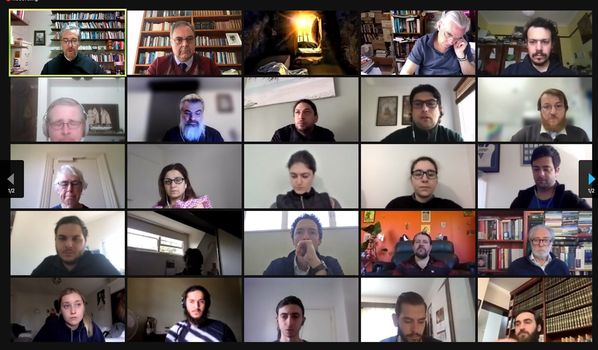 Fr Perry began by acknowledging and thanking His Eminence Archbishop Makarios of Australia for the invitation, before turning to the reality of sickness and death, which, he stated, is an old topic, insofar as it goes back to our progenitors and our creation by God, and our sin and fallenness that followed from that. From the position of our created finitude, this topic is of course intrinsically related to our approach to Christ who is the lover of humankind and the healer of our souls and bodies. But this topic is also new on account of advances in science, medical treatment, etc., which means—and here Fr Perry invoked Very Revd Prof. John Behr—that we no longer experience death frequently in our everyday lives, which, according to the latter, is a shift is more radical than any other in human history.
Fr Perry then emphasised three points, a) that sickness and death are personal for all of us, b) that death is one of life’s greatest mysteries, and that we should acknowledge the mystery of this topic and the absurdity of making sense of certain situations, and c) that the recently canonised St Sophrony the Athonite sheds a lot of light on this topic. Indeed, as the presentation progressed, Fr Perry made frequent references to not only St Sophrony, but also to Metropolitan John Zizioulas, Metropolitan Ierotheos Vlachos, and the late Very Revd Fathers Georges Florovsky and Alexander Schmemann, in order to delineate an Orthodox approach towards sickness and dying, and how this can illumine the imminent challenges posed by transhumanist ‘radical life extension’ (RLE) technologies.
Some salient points made by Fr Perry included that sickness and death can either revitalise someone’s spiritual life or lead them to despair, to a rejection of all things leading to faith; that suffering in human life is a collaborator in salvation, and sometimes spiritually often better than health itself; that the teaching from the Orthodox Church on these deepest of matters is grounded in Genesis 1:26, that we are both exalted by God yet dust of the earth—that embodied life is a gift from God and we are dependent upon our creator for life.
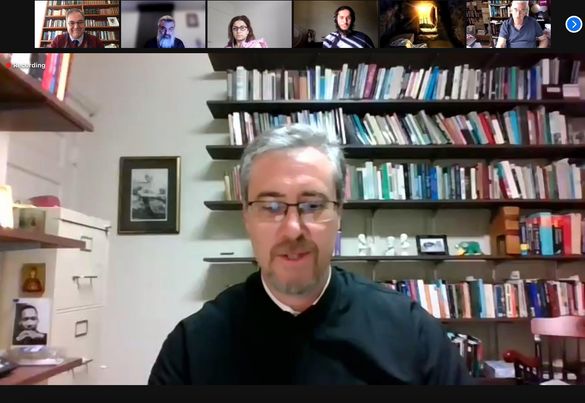 With all this in mind, Fr Perry gave evidence for the Orthodox Church’s acceptance and endorsement of the sciences and medicine when it comes to healing diseases and making life better for us all, before turning critically to the transhumanist phenomenon of ‘radical life extension.’ Sponsored by CEOs of tech giants like Jeff Bezos and Peter Thiel, this technology has as its goal the halting of the aging process through stem-cells, immunotherapy, etc., but it does not promise immortality, since existence continues to be embodied and does not rule out accidents.
Fr Perry then remarked that while advances in medicine contribute positively against fallen nature’s consequences, however there is a difference between increasing human life expectancy and extending human life span through RLE techniques. The latter, which involves tampering with genetics, is very problematic from an Orthodox Christian point of view, and Fr Perry explored several reasons why this is the case, emphasising the goal of human life is not simply comprising healthy biological existence—since this does not necessarily exhaust goodness—because our ultimate telos is to have eternal life and to have it abundantly in the eschatological age to come, when Christ returns.
Indeed, while we see in the scriptures Christ healing the sick and raising the dead, He does not extend anyone’s life indefinitely, and after resurrection, Christ did not remain on earth indefinitely. In other words, our ultimate purpose is to imitate Christ, to become by grace what Christ is by nature, which is not achievable through an extended stay on earth, because, to reiterate, our true telos is resurrected life in His kingdom. This talk was extremely interesting and thought provoking, and both faculty and students asked questions of Fr Perry who was very generous with his time.
Enrolments Now Open!
.jpg)
Study at St Andrew's

Subject Areas on Offer
Gallery
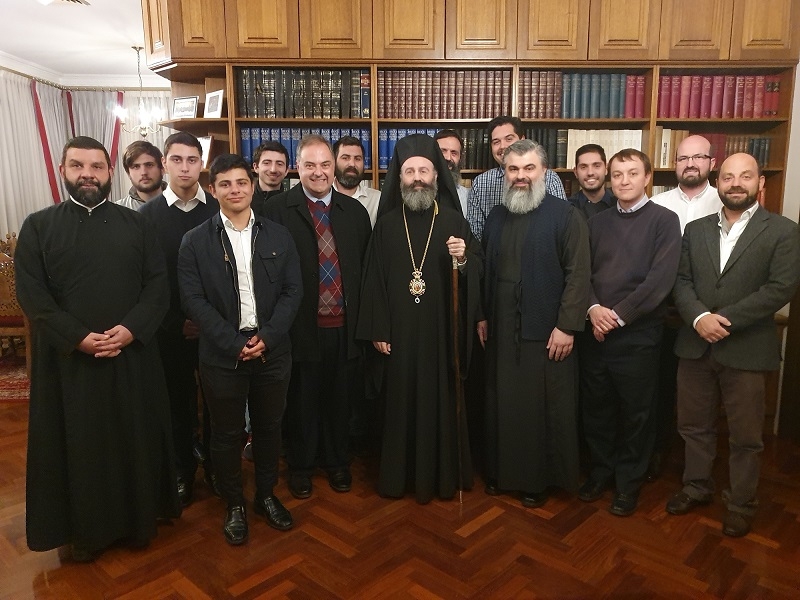
The Library

The library was established with the opening of St Andrew's in... see more
Subscribe to our Blog!
Subscribe to our blog written by our Faculty and learn more about your Orthodox Christian faith
Connect With Us
|
|
|
|
Join Our |


.png)
Copyright © 2019 St Andrew's Greek Orthodox Theological College.
All Rights Reserved. | Website Terms & Conditions