- Home
- About us
- Students
- Courses
- Research
- Library
- News & Events
- Gallery
- Contact
- Our Blog
Latest News

The Sunday of Orthodoxy
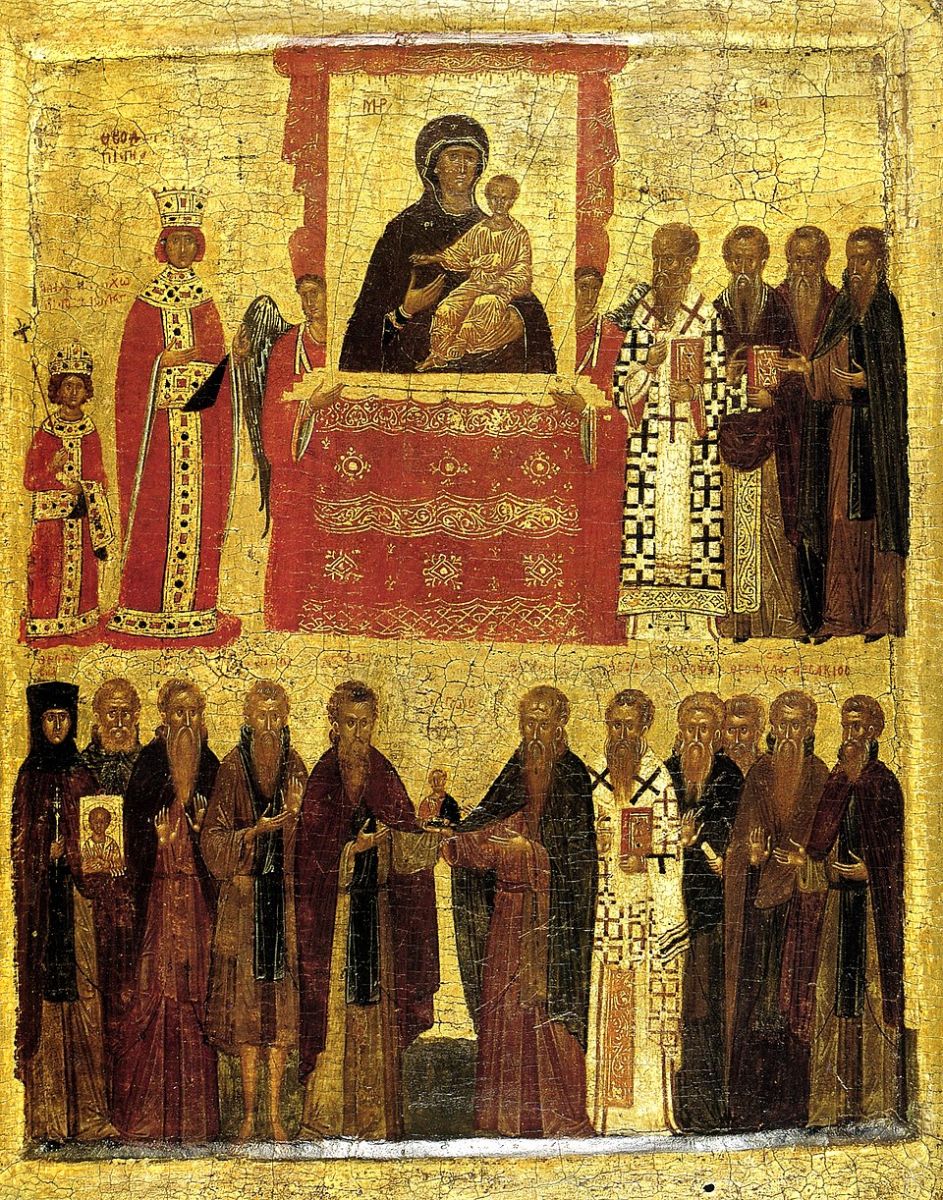
by Assoc. Professor Philip Kariatlis (Sub-Dean)
Within the liturgical tradition of our Church, the first Sunday of Holy and Great Lent is known as the ‘Sunday of Orthodoxy’. It is a day which commemorates the restoration of icons to the Church in 843AD and the definitive end of iconoclasm in Byzantium. For this reason, those attending Church on this day solemnly process with holy icons around the Church, giving visible expression to their confession of faith, and affirming the theological integrity and rightful place of icons within the life of the Church.Moreover, in their reverend procession, the faithful equally profess what they long and strive to become—living icons of God—especially through this sacred period within the liturgical life of the Church. Indeed, in venerating icons, the faithful confess their calling to holiness, in accordance with the Scriptures which affirm: “we all, with unveiled face, beholding the glory of the Lord, are being transformed into the same image from one degree of glory to another [τὴν αὐτὴν εἰκόνα μεταμορφούμεθα ἀπὸ δόξης εἰς δόξαν]”(2Cor3:18).And similarly, St John the Evangelist notes: “Beloved, we are God’s children now… and when He appears we shall be like him, because we shall see him as he is” (1 John 3:2). These verses express the mystery of our transformation into Christ’s likeness—becoming true icons of our Lord and participating, through grace, in the divine life of eternity.
Upon further reflection, icons are a theological proclamation to the truth and reality of our Lord’s Incarnation; they are eloquent ‘words’ in colour bringing us into the presence of our Lord and opening before us, silently, yet most emphatically, the endless horizons of God’s future kingdom in the here and now. In praying before an icon of Christ, Panagia and the saints, the Orthodox claim that the faithful are really and genuinely enabled to stand in their presence. To understand the Sunday of Orthodoxy is to understand, therefore, something essential about the Christian faith itself. Icons are not merely religious art or cultural artefacts. They are, as one Lenten hymn beautifully expresses it, a proclamation in colour that the eternal Son of God has entered human history to save the world. Within the Vespers Service on the evening before, the Church sings in a most striking manner:
“You who are uncircumscribed in divine nature, O Master, in the latter days were pleased to become incarnate and therefore circumscribed [σαρκωθεὶς ἠξίωσας περιγράφεσθαι]. For in Your assuming flesh, You also adopted all of its distinctive properties. Therefore, when we depict the image resembling Your outward form, and relatively reverence it, we are lifted up to a love for You [σχετικῶς ἀσπαζόμεθα, πρὸς τὴν σὴν ἀγάπην ὑψούμενοι]. From Your holy icon we draw the grace of healing; and in this we follow sacred traditions that the Apostles handed down” (Vespers, Sunday of Orthodoxy).
The hymn of this great feast day concisely encapsulates the profound theological meaning and significance of holy icons, reflecting precisely all that was articulated most definitively at the Council of Nicaea (in 787AD)—which subsequently came to be known as the Seventh Ecumenical Council.
The hymn in question affirms an important paradox at the very heart of Christian theology: God’s essence–His inherent being—is ‘uncircumscribed’, that is, beyond human expression and beyond human depiction. And yet, precisely because of the reality of the Incarnation, where the eternal Son of God assumed, in time, the fullness of our human nature—yet without sin—becoming visible and tangible, He can now be depicted by the Church without the danger of falling into idolatry. The icon therefore stands first and foremost as a confession of the Incarnation. It proclaims that the Son of God, our Lord Jesus Christ, did not merely appear within the world, but assumed our humanity—that “the Word became flesh and dwelt among us [ὁ λόγος σὰρξ ἐγένετο καὶ ἐσκήνωσεν ἐν ἡμῖν] and we have seen his glory, the glory as of a father’s only son,full of grace and truth”(Jn 1:14). Furthermore, in becoming human, Jesus sanctified all matter and restored all of creation to its original vocation as a bearer of divine glory. Every icon, therefore, is a silent sermon, a visual Gospel, calling us to contemplate the mystery of divine love revealed in Christ and the sacredness of materiality more broadly.
Yet the icon does more than teach about the reality and truth of the Incarnation; it invites and summons the beholder into communion. In venerating an icon, the faithful, in the words of the hymn “are lifted up” into the eternal presence of our loving God. Far more than mere artistic representations, icons bring us before a divine presence, and for this reason they are rightly referred to as “windows into heaven.” Through the icon, the beholder is lifted beyond the human representation, beyond the wood and the pigment, into a living and genuine relationship with Christ, His Mother and all the saints; all of whom are encountered, giving us, in this way, “glimpses into eternity.” Looking closely at an icon, we discern a transcendent beauty: calm faces, luminous gold backgrounds, an absence of theatrical emotion, all testifying to another order of reality—one permeated by the all-enfolding love of God. Icons show a world transfigured by the Resurrection, where suffering is redeemed, life stands victorious over death, and darkness is overcome by the resplendent and unfading light of our loving God. The icon does not deny the pain of human life, but it refuses despair, proclaiming instead that Christ has conquered death and opened before us the endless joy of His kingdom: “all reality if full of light, the heavens, the earth and the netherworld.”
Accordingly, icons are both a confession of faith and an invitation into God’s kingdom; and herein lies perhaps the deepest challenge of the Sunday of Orthodoxy. Icons are not only objects to be admired; they are mirrors in which we glimpse our own calling. If the saints are depicted in glory, it is because they became living icons of Christ through repentance, humility, and love. The Church carries icons in procession to remind us that holiness is not an abstraction. It is the destiny of every baptised person. We are all called to become living icons of God—transparent to His presence, radiant with His compassion, and steadfast in His truth. We are called to give witness to the hope of the light of Christ and the promise of His eternal kingdom here on earth, especially to those around us.
As we continue to journey through Holy and Great Lent, the Church invites us to find the time, even if only briefly, from the endless ‘noise’ of the world, and to stand in stillness and prayer before an icon, attentive to the mystery and silent words conveying the infinite love of God who became human to save us all and to enable us to enjoy His eternal beatitude. More than that, the Sunday of Orthodoxy summons us to learn to discern the presence of Christ in every human face, because as living icons, the crucified and risen Lord comes to meet us concretely in our neighbour, especially those suffering and forgotten. Every human person, created in the image and likeness of God “κατ᾽εἰκόνακαὶκαθ᾽ὁμοίωσιν” (cf. Gen 1:26) is an epiphany of God! Thus we are reminded by the Church, on the Sunday of Orthodoxy, that in venerating icons we can begin, already in the here and now, to taste of the life of the age to come—the radiant kingdom in which Christ is all in all, and where each person, transformed by grace, is called to become a living icon of His eternal and inexhaustible love.
| About the Author |
Associate Professor Philip Kariatlis Sub-Dean of St Andrew's Greek Orthodox Theological College Associate Professor Philip Kariatlis is Academic Director and Associate Professor in Theology at St Andrew's. After taking an undergraduate degree in Theology from St Andrew's, he graduated from the University of Sydney with a degree in Arts, majoring in Modern Greek. He received a Master of Theology and a doctorate from the Sydney College of Divinity, where he studied under Professor Gerard Kelly. His doctorate was in the area of ecclesiology where he examined the notion of koinonia ... |
Useful links
Subscribe to our Blog!
Subscribe to our blog written by our Faculty and learn more about your Orthodox Christian faith
Connect With Us
|
|
|
|
Join Our |


.png)
Copyright © 2019 St Andrew's Greek Orthodox Theological College.
All Rights Reserved. | Website Terms & Conditions