- Home
- About us
- Students
- Courses
- Research
- Library
- News & Events
- Gallery
- Contact
- Our Blog
Latest News

The Ladder Hidden in the Cross:
A Lenten Reflection
by Assoc. Professor Philip Kariatlis (Sub-Dean)
We are all aware that this coming Sunday—the Fourth Sunday of Holy and Great Lent—is dedicated to the memory of Saint John of the Ladder. Yet have we paused to consider how last Sunday’s feast of the Cross relates to this commemoration? This brief reflection seeks to suggest the deeper organic connection between them.
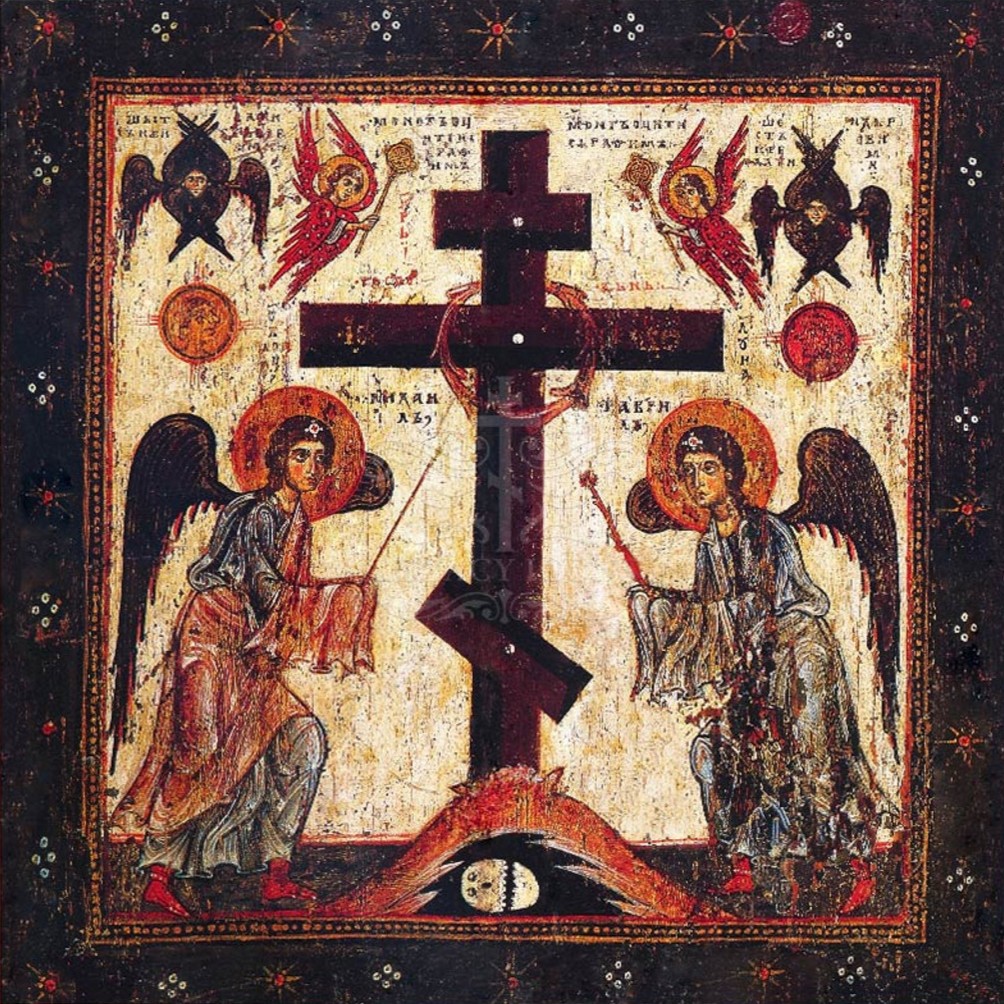
Last Sunday’s liturgical celebration of ‘the Precious and Life-Giving Cross’ offered us a profound opportunity to contemplate the depth of God’s love revealed in the great mystery of the Cross. The hymns of the day made it clear that the Cross stands as the supreme symbol of divine love and—even, paradoxically, of joy—for, as we heard, in it we behold the immeasurable extent to which God goes for the salvation of the world. This is of fundamental importance, and it is precisely for this reason that the foundation of the Christian life lies precisely in our continual reflection on the Cross of Christ since in it weare brought before the mystery of God’s love in a most immediate way—indeed, opening up before us, more broadly, the endless treasures of His manifold blessings and benefactions upon the world.
Through Christ’s self-offering on the Cross, we are not only delivered from sin, but drawn into the pre-eternal and loving purpose of God: that we might participate in His divine life for all eternity. Indeed, it was upon the Cross that God’s pre-eternal will—that the human person should share in and enjoy His eternal beatitude—was most perfectly brought to fulfilment.
The mystery of the Cross, therefore, truly surpasses human comprehension. That the Son of God should endure rejection, humiliation, and death reveals a love both unfathomable and transformative. In his Counsels on the Spiritual Life, Saint Mark the Monk (late 4th to 5th cent.) reflects at length on the extent of God’s love as seen through the Son of God’s condescension on earth culminating in His loving self-sacrifice on the Cross. He writes the following:
Remember always and reflect upon such profound humility which the Lord in His ineffable compassion took upon Himself because of His love for us. That is, God the Word coming to dwell in His mother's womb; His taking human nature upon Himself; His birth from a woman; His gradual growth in physical stature; the dishonour He suffered; the insults, the vilifications, the ridiculing jokes; the revilings, the beatings, being spat upon and jeered; the purple robe, the crown of thorns; the judgment against Him by those in authority; the outcry against Him by the lawless Jews, who were His own people, “Away with him! Crucify him!”; the cross, the nails, the spears, the drink of sour wine and gall; the derision of the pagans; the laughter of those passing by and saying, “If you are the Son of God, come down from the cross right now and we will believe in you!” And the rest of the sufferings that He patiently endured for our sakes: crucifixion, death, three-day burial in the tomb, the descent into hell.[1]
It is precisely through the Cross and all the humiliation that Christ suffers that His victory over death comes to be manifested in His Resurrection, thereby establishing the “pattern of our new life” for us all. As well As St Paul affirms, He is declared to be the Son of God with power according to the Spirit of holiness by “resurrection of the dead” (cf. Rom 1:4)—and it is this very life that He now bestows upon us.
It is worth noting that many, if not all, English translations of Romans 1:4 render this phrase as “resurrection from the dead,” which suggests that Christ’s own rising is the sole point of emphasis. However, the Apostle’s language in the original Greek is clear—ἐξ ἀναστάσεως νεκρῶν—suggesting something profoundly greater: Christ is revealed as the Son of God precisely in that He is the source and giver of our resurrection. In other words, the wonder of the Resurrection lies not only in His rising, but in His power to raise us also. This is the true miracle of divine love—that He who conquers death does so not for Himself alone, but in order to bestow life upon all. And this is precisely what we will sing on Easter day: “Christ is risen from the dead, by death trampling upon death and on those in the tombs bestowing life.”
And so, in dedicating a particular Sunday to the veneration of ‘the Life-Giving Cross’, the Church invites us to place the Cross at the very centre of our daily existence as well. It is through continual reflection upon this mystery that we come to recognise anew the fullness of God’s saving work and the innumerable blessings granted to us. In this way, the Cross becomes not only the foundation of our faith, but the enduring source of our hope, our transformation, and our participation in the life of God.
Now, if the Cross reveals to us the kenosis of God—the unfathomable extent to which the Son of God humbles Himself out of love for the world—then it also discloses the paradox at the very heart of the Christian mystery: that true exaltation is found precisely through kenosis or humility. As the Apostle Paul writes in his Epistle to the Philippians, Christ “humbled Himself and became obedient unto death, even death on a cross. Therefore, God has highly exalted Him and bestowed on Him the name which is above every name” (Philippians 2:8–9). In this inseparable movement of descent and exaltation, we are shown not only who God is, but also the path by which we are called to follow Him.
It is therefore most fitting that, in the fourth Sunday dedicated to Saint John of Climacus, the Church invites us to reflect more deeply on our own ascent toward God. If the Cross reveals the divine pattern, St John offers a spiritual map by which this pattern may be realised within the life of the believer. In his Ladder of Divine Ascent—aChristianclassic—humility stands at the very centre of the soul’s journey, not as one virtue among many, but as the indispensable condition for encountering Christ. For it is the humble person—one who seeks not their own will, but the will of God—who becomes receptive to divine grace and capable of true transformation.
What is particularly striking in St John’s work is the depth of his spiritual insight. The Ladder is not concerned merely with outward conduct or the visible manifestations of virtue. Rather, it penetrates into the inner life of the soul, into the hidden and often concealed movements of the heart, where the true spiritual struggle unfolds. His emphasis is not on appearances, but on authenticity before God. He writes, for example:
to exalt oneself is one thing, not to do so another, and to humble oneself is something else entirely. A person may always be passing judgement on others, while another passes judgement neither on others nor on themselves. A third, however, though actually guiltless, may always be passing judgement on themselves.[2]
This teaching shows that true humility is not defined by outward behaviour, but by the inner disposition of the soul. One may appear restrained or even virtuous externally, yet still harbour judgment or self-regard within; whereas genuine humility is revealed in the heart that, even when blameless, remains inwardly watchful, self-critical, and wholly oriented toward God rather than self.
Thus, one may appear outwardly humble—gentle in speech, modest in the way they carry themselves—yet inwardly be driven by an insatiable desire for recognition, affirmation, or praise. In such cases, humility becomes superficial, deprived of its true substance. It is no longer a genuine self-emptying, but a subtle form of self-seeking, clothed in the language of virtue. The longing for the approval of others, for flattering words and affirmation, reveals that the heart has not yet been freed from the tyranny of self-love.
St John therefore calls us to a far more demanding path: a humility that is hidden, interior, and authentic—a humility that seeks nothing for itself, but rests and surrenders entirely in God. It is this humility, mirroring the self-emptying of Christ on the Cross, that becomes the true ladder by which the soul ascends, not by its own strength, but by grace, into the life of God. May we all be strengthened and in the words of St John, may we to go forth from this day on, and “add light to light…. glory to glory and knowledge to knowledge”[3]—ever advancing in the way of Christ and His unfading joy!
With warmest wishes as we all “stretch forward to what lies ahead” (Phil 3:13) in our respective journeys—as one body, Christ’s body, united in both heart, soul and mind—towards encountering the crucified and risen Lord.
[1]St Mark the Monk, A Letter to Nicholas, 5.
[2]St John Climacus, The Ladder of Divine Ascent, Step on Humility.
[3]St John Climacus, Ladder of Divine Ascent, Step on Discernment.
| About the Author |

Associate Professor Philip Kariatlis Sub-Dean of St Andrew's Greek Orthodox Theological College Associate Professor Philip Kariatlis is Academic Director and Associate Professor in Theology at St Andrew's. After taking an undergraduate degree in Theology from St Andrew's, he graduated from the University of Sydney with a degree in Arts, majoring in Modern Greek. He received a Master of Theology and a doctorate from the Sydney College of Divinity, where he studied under Professor Gerard Kelly. His doctorate was in the area of ecclesiology where he examined the notion of koinonia ... |
Subscribe to our Blog!
Subscribe to our blog written by our Faculty and learn more about your Orthodox Christian faith
Connect With Us
|
|
|
|
Join Our |


.png)
Copyright © 2019 St Andrew's Greek Orthodox Theological College.
All Rights Reserved. | Website Terms & Conditions