- Home
- About us
- Students
- Courses
- Research
- Library
- News & Events
- Gallery
- Contact
- Our Blog
Latest News

When Eternity Draws Near:
Mary and the Mystery of Beauty
by Dr Andrew Mellas (Senior Lecturer in Church History and Liturgical Studies)
The haunting opening lines of Rainer Maria Rilke’s ‘Duino Elegies’ portray divine beauty as an encounter with eternity—one that draws us in even as it destabilises the fragile fixities of human existence: “Who, if I cried out, would hear me among the angelic orders? And even if one of them pressed me suddenly to his heart: I’d be consumed in his more potent being. For beauty is nothing but the beginning of terror, which we can still barely endure...”. There is a disquieting paradox at the heart of divine encounter. Beauty is not always a consolation. It is an overwhelming irruption of the mysterium tremendum into human existence. The experience of the divine is as perilous as it is transformative.
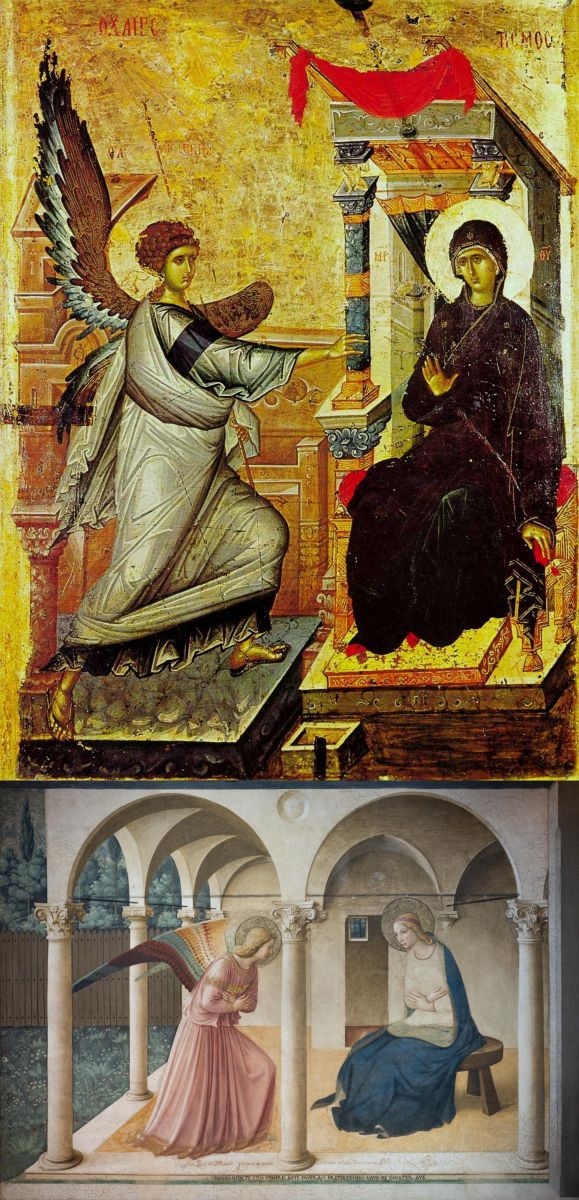
This profound tension finds a striking visual expression in the fourteenth-century Ohrid icon of the Annunciation. The Virgin Mary’s raised hand evokes this decisive moment when human freedom recoils in awe before the divine mystery that Archangel Gabriel betokens—and yet chooses to draw closer to it. This Byzantine icon is an intriguing contrast to the tranquil beauty of Fra Angelico’s fifteenth-century depiction of the Annunciation as a peaceful and yet theologically profound moment in salvation history. Very little seems to happen and yet everything happens. The stillness of the scene reveals the true drama as the one unfolding in “the hidden person of the heart” (1 Peter 3:4), in the freedom of the Virgin Mary as she beholds the mystery of salvation. If the Ohrid icon captures the moment of encounter, Fra Angelico reveals its fulfilment: the peace that emerges when human freedom embraces divine will.
Although the Akathist Hymn—that renowned Byzantine song of devotion to the Mother of God—was composed centuries before these two icons, its vision of salvation unites their iconographic narratives, gently dissolving the contrasts that distinguish them. With its cascading invocations of delight—“Rejoice, you through whom joy shall shine forth! Rejoice, bridge leading those from earth to heaven”—and its memorable refrain, “Rejoice, O unwedded Bride”, the hymn traverses the emotional register of various biblical scenes. Rather than simply confining itself to the joyful event of the Annunciation, it unfolds as a cosmic mystery, one that reverberates throughout creation and the heavens. The Virgin’s “yes” is not merely a personal response; it is a cosmic rejoinder to the revelation of the pre-eternal mystery of salvation. And so, it could never be portrayed as simply a chance encounter between an angel and a woman.
Pope Benedict XVI once described this ancient hymn as “one of the highest expressions of the Marian piety of the Byzantine tradition,” noting that it “opens wide the heart and disposes it to the peace that is from above” (Verbum Domini, §88). That peace, however, is not the absence of tension—it is the transfiguration of it. The Akathist Hymn teaches us to see that the “terror” of divine beauty and the serenity of holy peace are not opposites; they belong together. The overwhelming presence of God does not destroy human freedom; it calls it forth, elevates it and brings it to fulfilment.
Perhaps most strikingly, the Church places this delightful hymn within the penitential season of Lent. The feast of the Annunciation on 25 March and the Saturday of the Akathist interrupt the austerity of the season with bursts of light. This is no liturgical accident. It reveals something essential about the logic of salvation and grammar of doxology. Even in the most sombre moments of repentance and compunction, the light of Pascha is already dawning. The Cross is already illuminated by the day that knows no evening, and the sorrow of Lent is being coloured with joy.
The faithful revisit these mixed emotions during the mysterious interval between the Crucifixion and Resurrection of Christ, when the Gospel and hymnography offer us a guide through this terrible uncertainty: St Mary Magdalen. Mary is “conquered by weeping and overcome by love” as she searches for the body of Christ: it was dark, “but love lighted the way” (St Romanos the Melodist). She mistakes him for the gardener, because she confuses Christ, the second Adam, with the first Adam and his role in the Garden of Eden, caring for the earth and naming the animals. However, upon hearing the voice of her shepherd, her grief is “changed to joy” and she is “seized with the fire of love”. And yet, when Mary is finally granted the joy of seeing and hearing Christ, she is denied the fulfilment of that longing. Mary wished to grasp the One who fills all creation, but the Creator led her up to things divine, saying: “Do not touch me.” We know how the story of salvation begins, we know its twists and turns, and we know how it ends, but the Orthodox Church and her hymns invite us to experience the story of salvation as a mystery that is being revealed, as a new day that is already dawning, but also as a mystery that is yet to come.
The Annunciation, then, is not simply a past event to be remembered. It is a mystery that continually unfolds: the moment in which divine beauty approaches human freedom, not to overwhelm it, but to invite it into communion. Like Mary, the faithful stand at that threshold—drawn, unsettled and called to respond. And in the answer we may choose to offer, a feeling of terror can be transformed into a song of joy.\
| About the Author |

Dr Andrew Mellas Senior Lecturer in Church History and Liturgical Studies Andrew Mellas is Senior Lecturer in Byzantine History & Liturgical Studies at St Andrew's. In 2018, he completed a Doctor of Philosophy at the University of Sydney on the emotion of compunction in Byzantium. Andrew has published various chapters and articles on the history of Byzantium, liturgics and hymnody in peer-reviewed publications and journals, as well as presenting papers on these subjects at international conferences. He is also a member of the Australian Byzantine Choir... |
Subscribe to our Blog!

Subscribe to our blog written by our Faculty and learn more about your Orthodox Christian faith
Connect With Us
|
|
|
|
Join Our |


.png)
Copyright © 2019 St Andrew's Greek Orthodox Theological College.
All Rights Reserved. | Website Terms & Conditions