- Home
- About us
- Students
- Courses
- Research
- Library
- News & Events
- Gallery
- Contact
- Our Blog
Latest News

The Service of Holy and Great Tuesday Evening
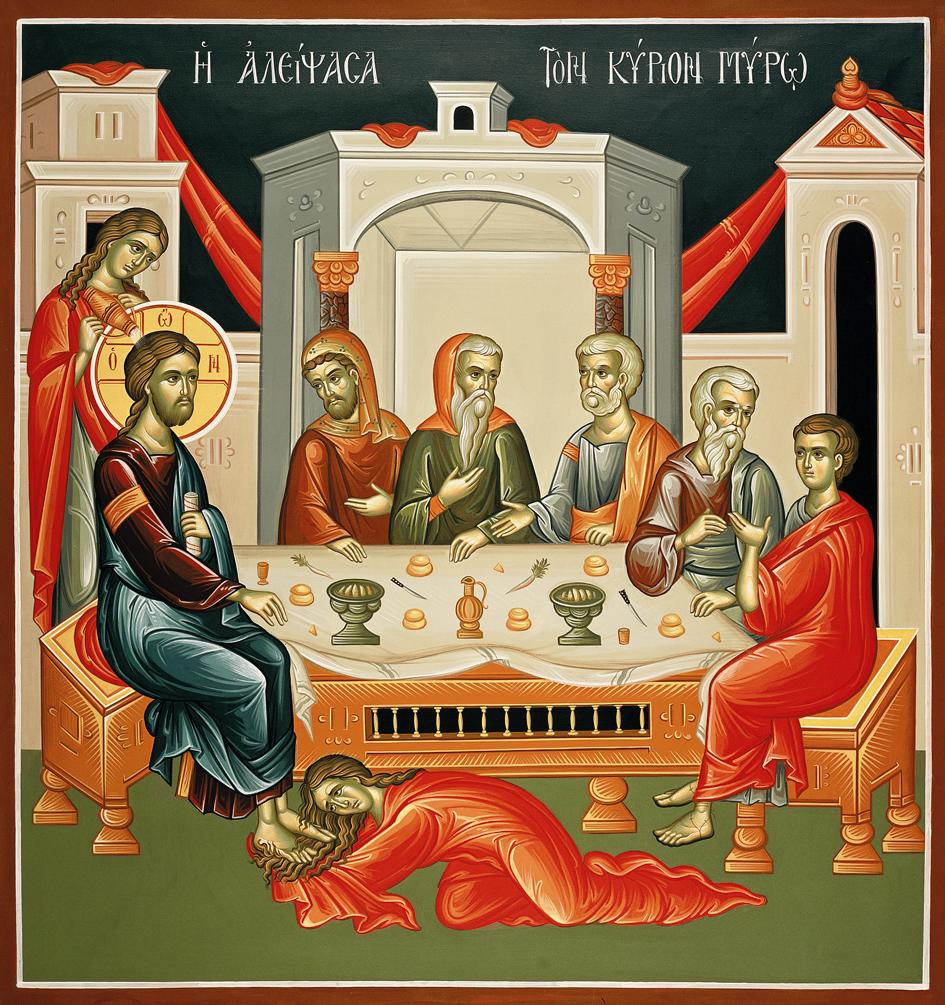
by by Assoc. Professor Philip Kariatlis (Sub-Dean)
A woman, reeking and defiled, approached You, O Savior. She drenched Your feet with her tears, and thus announced Your Passion. “How can I look at You the Master? For You have come to save a harlot. Dead that I am, raise me up from the depths, You who raised Lazarus from the tomb after four days. Accept me, wretch that I am, O Lord, and save me.”
Προσῆλθε γυνὴ δυσώδης καὶ βεβορβορωμένη, δάκρυα προχέουσα ποσῖ σου Σωτήρ, τὸ Πάθος καταγγέλλουσα. Πῶς ἀτενίσω σοι τῷ Δεσπότῃ; αὐτὸς γὰρ ἐλήλυθας σῶσαι πόρνην. Ἐκ βυθοῦ θανοῦσάν με ἀνάστησον, ὁ τὸν Λάζαρον ἐγείρας ἐκ τάφου τετραήμερον. Δέξαι με τὴν τάλαιναν, Κύριε, καὶ σῶσόν με.
Hymn from the Aposticha
The service of Holy and Great Tuesday evening—liturgically the Orthros service of Wednesday morning—commemorates a harlot woman whose profound repentance led her before the feet of Christ. There, she sought to anoint them not only with costly fragrant myrrh but also with the tears of her own contrite heart.[1] Our Lord’s boundless love towards her—and by extension to all of us as well—brought about the remission of her former sinful ways. Indeed, within the Service, her decisive turn away from a life of sin and her deep renewal in Christ are rendered all the more striking when set in stark contrast to the actions of one of Christ’s disciples, Judas, whose inordinate love for money culminated in the betrayal of his Master and Lord. We have here two entirely different responses to Christ—that of repentance and rejection; the unknown harlot walks towards the Light of Christ whilst the other, a close disciple of Jesus, turns away, spurning Christ even while standing within His loving presence.
Most certainly, this evening is also especially well-known for the deeply moving 9th century Byzantine composition attributed to Kassiani—the celebrated ‘Hymn of Kassiani’ as it is commonly referred to—chanted towards the end of the service which gives voice, with remarkable poetic and theological depth, to the interior world of repentance. Taken together, all the hymns and readings of the evening invite the faithful to plunge deeply into the depths of their own hearts and to awaken a spirit of compunction and repentance, together with thanksgiving and glorification towards God. This state may fittingly be described as doxological contrition, wherein the recognition of the faithfuls’ own sins are intended to lead to true repentance inseparably bound to praise and thanksgiving towards God for His infinite mercy and philanthropia—His interminable love for humankind.
Throughout the Scriptures, we are consistently reminded that it is not outward appearances or actions—such as those exemplified by the Pharisees for example or, in this case, Judas’ proximity to Christ—that render one a true follower of Christ, but rather a genuine and interior striving to reorient one’s entire being toward the love of God. This is precisely the meaning of repentance—metanoia: a decisive turning away from sin and a turning toward the liberating joy and delight found in communion with Christ; a reorientation of one’s life from darkness to light; the resplendent and unfading light of Christ. To outward appearance, Judas might well have been regarded as a true disciple, for he was physically present with the Lord throughout His earthly ministry. Yet it is the unknown sinful woman who is revealed as the one who truly follows Christ. In this way, the Scriptures overturn superficial judgments, directing us instead to the inner disposition of the heart, wherein authentic discipleship is found.
It is precisely this contrastive parallel between the harlot and Judas that the Service of Holy and Great Tuesday so strikingly establishes. In doing so, it unveils the true nature of repentance—not as a mere guilt, self-reproach and remorse—but as a profound reorientation of the entire person toward Christ. Beyond its poetic elegance, the following hymn—worth quoting in full—articulates with theological precision the radical divergence between these two figures, thereby illuminating the path of salvation and summoning a living response from each of us.
When the sinful woman offered the fragrant oil, then the disciple made his agreement with the transgressors of the Law. She rejoiced in pouring out the costly oil, and he lost no time in selling off the priceless One. She acknowledged the Master, and he was becoming estranged from the Master. She was emancipated, while Judas became a slave of the enemy. How dreadful was his rashness! How great was her repentance! Grant me this repentance, O Savior who suffered for us, and save us.[2]
Through this carefully ordered sequence of contrasts—“she offered… he made an agreement”; “she acknowledged the Master… he became estranged”; “she was emancipated… Judas became a slave,” culminating in the exclamation, “How dreadful was his rashness! How great was her repentance!”—the believer is drawn inward into a moment of sober self-examination and introspection. Having contemplated these two divergent paths, we are not to remain untouched. Rather, through inward reflection, we are invited to come to recognise that we too stand between these same possibilities. The contrast is thus interiorised, and the hymn is meant to give voice to our own supplication, placing upon our lips the prayer: “Grant me repentance, O Saviour.”
It must be pointed out that the Scriptures do in fact reveal that Judas experienced remorse—in the Gospel according to St Matthew for example, we read: “When Judas, his betrayer, saw that Jesus was condemned, he felt regret (μεταμεληθεὶς)[3] and brought back the thirty pieces of silver to the chief priests and the elders” (Mt 27:3). The distinction, however, between regret or remorse and true repentance (μετάνοια) is that whilst the former focuses on a past action bringing about an all-consuming self-reproach—where one is unable to forgive themselves—it does not lead to a radical reorientation and transformation beyond the self to Christ. It can often remain self-enclosed and self-centred, failing to turn towards Christ in humility and trust in his divine mercy and love for humankind. The Patristic tradition is unanimous in teaching that there is no sin which cannot be forgiven except the sin of not repenting. The hymn of Kassiani teaches in a profoundly moving way: “Who can search out the multitude of my sins and the depths of Your judgments, O Savior of my soul? [Ἁμαρτιῶν μου τὰ πλήθη καὶ κριμάτων σου ἀβύσσους, τίς ἐξιχνιάσει, ψυχοσῶστα Σωτήρ μου;]” The phrase acknowledges the immeasurable multitude of one’s sins and the unfathomable depths of God’s mercy and judgments, confessing, at the same time, that both lie beyond human comprehension before Christ, the Savior of the soul. Tragically, Judas’ remorse was such that it did not believe that Christ would forgive him. It is precisely for this reason that remorse alone is not salvific; sorrow must become hope-filled trust in God’s love.
A similar hymn, which not only intensifies the disparity between the harlot and Judas through its striking juxtapositions and deeply emotive language, but also goes further by unveiling the hidden motive that underlies Judas’ betrayal, is the following:
Oh, the wretchedness of Judas! He watched as the harlot was kissing Your feet, all the while with guile thinking about the kiss of betrayal. As she untied her braided hair, he was knotted up in anger, bringing rancid wickedness instead of fragrant oil. For envy does not know where there is profit [φθόνος γὰρ οὐκ οἶδε προτιμᾶν τὸσυμφέρον]. Oh, the wretchedness of Judas! From this deliver our souls, O God." can you briefly reflect on this and draw attention to the profoundly theologically incisive point "envy does not know where there is profit.[4]
Here the hymn, reminiscent of the Scriptural scene found in St John’s Gospel where Mary, the sister of Lazarus, anoints the feet of Jesus and wipes them with her hair whilst Judas stands overcome with dark and disordered thoughts (cf. Jn 12:1-8), discloses the true meaning of discipleship: a life marked by a total turning and authentic devotion to Christ manifested in humble, costly, self-emptying love. In the case of the woman described in the hymn, her true devotion to Jesus is expressed through her embodied gestures—kissing Christ’s feet, loosening her hair, and pouring out fragrant oil—each act ultimately revealing an offering of her very inner self. The striking intensity of the scene is once again heightened by the presence of Judas, one of the Twelve, who outwardly stands beside his Master, yet inwardly is overcome with anger and already inclines toward betrayal.
The profound theological insight of the hymn lies in its diagnosis of envy as the driving motive behind Judas’ actions. Envy is more insidious than mere jealousy: it is not simply an inner sorrow at another’s good, nor even a passing resentment, but a disposition that seeks the very diminishment—indeed, the destruction—of the other. Yet the hymn reveals a deeper truth: rather than effecting the downfall of its object, envy clouds one’s self-perception, it turns inward and brings about one’s own ruin. In his letter to the Corinthians, the apostle Paul intimates the same: he writes that love “does not envy” and “does not seek its own” (1 Cor 13:4–5), revealing in contrast to love, that envy is inherently self-regarding and disordered.
The overarching theme relating to the tragic possibility of remaining in close proximity to Christ without the inner transformation born of a repentant heart is further illuminated in the appointed Gospel reading (John 12:17–50) of the Service. Here, Jesus discloses the true meaning of discipleship: a path marked by sacrifice, a dying to the old self, and a turning away from darkness, so that He may renew the human person from within and illumine them with His divine and unfading light. Indeed, the passage from darkness to light, from death to life, is precisely the meaning of repentance.The Gospel recounts that when certain Greeks came seeking to see Jesus, He alluded to his saving Passion and resurrection, thereby indicating that those who wishing to follow Him must enter into the same mystery. As he declared: “Those who love their life lose it, and those who hate their life in this world will keep it for eternal life[ὁφιλῶντὴν ψυχὴν αὐτοῦἀπολλύει αὐτήν, καὶ ὁμισῶν τὴν ψυχὴν αὐτοῦἐν τῷκόσμῳτούτῳεἰς ζωὴν αἰώνιον φυλάξει αὐτήν]” (Jn 12:25). That is, following Christ implies the relinquishment of the old self so as to be transfigured by divine grace. Thus, the passage lays bare not only the tragic possibility of proximity without transformation, but also—and most importantly—the condition for a genuine encounter with Christ: a desire to seek His light and no longer wishing to remain in darkness. The Gospel concludes with the consoling proclamation that turning to Christ and His Father—the meaning of repentance— is itself “eternal life” (cf. Jn 12:50).
Having underscored the necessity of true repentance, whereby we become receptive to the abundant gifts of Christ’s life and love, the Service concludes with the Hymn of Kassiani. This hymn once more recounts, with striking dramatic force, the life of a woman once lost in sin, who—through profound repentance—comes to perceive with clarity the divinity of Christ. The faithful are not invited merely to admire her repentance, but to recognise in themselves a life that has missed the mark and stands in need of renewal, and thus to identify personally with her final plea: “Do not despise me, Your servant, for Your mercy is without measure.” It is fitting, therefore, to conclude this reflection with the hymn in full:
Lord, when the woman who had fallen into many sins perceived Your divinity, she assumed the role of a myrrh-bearing woman, and lamenting brought fragrant oils to anoint You before Your burial. “Woe is me,” she says. “Night for me is a frenzy without restraint, very dark and moonless, a sinful love-affair. Accept the fountains of my tears, You who draw out from the clouds the water of the sea. Take pity on me, and incline to the sighing of my heart, You who bowed the heavens by Your ineffable self-emptying. I shall cover Your unstained feet with kisses, and wipe them dry again with the locks of my hair; those feet, whose sound at twilight in Paradise echoed in Eve’s ears, and she hid in fear. Who can reckon the multitude of my sins, or fathom the depths of Your judgments, O my life-saving Savior? Do not despise me, Your servant, since without measure is Your mercy.”
[1]The harlot woman depicted in the service refers primarily to the Gospel account in Gospel of Luke 7:36–50, where a sinful woman approaches Jesus, washes His feet with her tears, and anoints them in a gesture of deep repentance. The Church, however, also brings into view a second anointing from the Gospel of John (John 12:1–8), where Mary of Bethany anoints Christ’s feet with costly perfume, prompting Judas’ objection because of its expense. By placing these two accounts together, the hymnography presents both the repentance of the sinful woman and the reaction of Judas. Although these Gospel narratives are not identical and cannot be strictly harmonised, the Church unites them theologically in order to convey a deeper truth: it is not mere proximity to Christ that matters, but one’s inner movement toward Him.
[2]Ὅτε ἡἁμαρτωλός, προσέφερε τὸμύρον, τότε ὁμαθητής, συνεφώνει τοῖς παρανόμοις· ἡμὲν ἔχαιρε κενοῦσα τὸπολύτιμον, ὁδὲἔσπευδε πωλῆσαι τὸν ἀτίμητον· αὕτη τὸν Δεσπότην ἐπεγίνωσκεν, οὗτος τοῦΔεσπότου ἐχωρίζετο· αὕτη ἠλευθεροῦτο, καὶὁἸούδας δοῦλος ἐγεγόνει τοῦἐχθροῦ. Δεινὸν ἡῥαθυμία! μεγάλη ἡμετάνοια!ἣν μοι δώρησαι Σωτήρ, ὁπαθῶν ὑπὲρ ἡμῶν, καὶσῶσον ἡμᾶς.
[3]In some English translations this is even translated as “… he [Judas] repented.” These fail to note the distinction in the Greek between μετάνοια(repentance) and the word μεταμεληθείς comes from the verb μεταμέλομαι, which means to feel regret.
[4]Ὦτῆς Ἰούδα ἀθλιότητος! ἐθεώρει τὴν πόρνην φιλοῦσαν τὰἴχνη, κα ἐσκέπτετο δόλῳ, τῆς προδοσίας τὸφίλημα. Ἐκείνη τοὺς πλοκάμους διέλυσε, καὶοὗτος τῷθυμῷἐδεσμεῖτο, φέρων ἀντὶμύρου, τὴν δυσώδη κακίαν· φθόνος γὰρ οὐκ οἶδε προτιμᾶν τὸσυμφέρον. Ὦτῆς Ἰούδα ἀθλιότητος!ἀφʼἦς ῥῦσαι ὁΘεὸς τὰς ψυχὰς ἡμῶν.
| About the Author |

Associate Professor Philip Kariatlis Sub-Dean of St Andrew's Greek Orthodox Theological College Associate Professor Philip Kariatlis is Academic Director and Associate Professor in Theology at St Andrew's. After taking an undergraduate degree in Theology from St Andrew's, he graduated from the University of Sydney with a degree in Arts, majoring in Modern Greek. He received a Master of Theology and a doctorate from the Sydney College of Divinity, where he studied under Professor Gerard Kelly. His doctorate was in the area of ecclesiology where he examined the notion of koinonia ... |
Subscribe to our Blog!

Subscribe to our blog written by our Faculty and learn more about your Orthodox Christian faith
Connect With Us
|
|
|
|
Join Our |


.png)
Copyright © 2019 St Andrew's Greek Orthodox Theological College.
All Rights Reserved. | Website Terms & Conditions