- Home
- About us
- Students
- Courses
- Research
- Library
- News & Events
- Gallery
- Contact
- Our Blog
Latest News

Our God the First Born from the Dead and the Cosmic Midwife:
A reflection on the Resurrectional Apolytikion in Tone 3
by Dr Lydia Gore Jones (Senior Lecturer in Biblical Studies)
Every Sunday in church, we hear the dismissal hymn (or the Apolytikion) of the week on the theme of the Resurrection. On the fourth Sunday of Pascha on May 3, 2026, the hymn of the Resurrection was in Tone 3. Everyone could feel the brightness and joyfulness in the tune, but did you hear what the hymn was saying? If, like me, you hear the words again, reread and savour them, and take them to your mind and your heart, you will be truly amazed. Here is the hymn in Greek and in English translation:
|
Εὐφραινέσθω τὰ οὐράνια, ἀγαλλιάσθω τὰ ἐπίγεια, ὅτι ἐποίησε κράτος ἐν βραχίονι αὐτοῦ, ὁ Κύριος· ἐπάτησε τῷ θανάτῳ τὸν θάνατον· πρωτότοκος τῶν νεκρῶν ἐγένετο· ἐκ κοιλίας ᾅδου ἐῤῥύσατο ἡμᾶς, καὶ παρέσχε τῷ κόσμῳ τὸ μέγα ἔλεος. |
Let the heavens be glad; let the earth rejoice exceedingly, for the Lord has shown strength with His arm. He trampled death by death. He became the first-born of the dead. Out of the belly of Hades, He has delivered us, and to the world He has granted the great mercy. |
The rich image in the hymn is communicated in simple and direct sentences. All things in heaven and on earth are summoned to rejoice exceedingly, and to witness the powerful deed of the Lord. What powerful deed? He trampled down death by death; He became the first-born of the dead; He delivered us from the depths of Hades; and He gave great loving-kindness to the whole universe.
The resonant voices of scriptures are unmissable. “Let the heavens be glad and the earth rejoice” is from Psalm 96:11 (LXX 95:11), except that, instead of calling on “the heavens” (οἱοὐρανοί) and “the earth” (ἡγῆ) themselves as in the Psalm, the hymn summons each and every being – the hosts that fill the heaven above and creatures and even inanimate things that cover the earth below (τὰοὐράνια, τὰἐπίγεια), to exult in a marvellous truth.
Secondly, the words, “the Lord has shown strength [or done a great deed] with His arm,” call to mind not only His act of Creation (e.g., in Jeremiah 27:5: “It is I who by my great power and my outstretched arm have made the earth, with the people and animals that are on the earth…”) but also immediately the Passover and the crossing of the Sea in the Exodus event (e.g., in Deuteronomy 26:8: “The Lord brought us out of Egypt with a mighty hand and an outstretched arm, with a terrifying display of power, and with signs and wonders…”). But ultimately the words in Greek are quoted exactly from the song of Mary known as Magnificat in Luke 1:51, where the Theotokos, now with child, “rejoices (ἠγαλλίασεν)” in God the Saviour.
And a third scriptural reference lies in calling Christ the “first-born of the dead,” from St Paul’s letter to the Colossians, whose words are worth quoting here:
[Christ] is the image of the invisible God, the firstborn of all creation; for in him all things in heaven and on earth were created, things visible and invisible, whether thrones or dominions or rulers or powers—all things have been created through him and for him. He himself is before all things, and in him all things hold together. He is the head of the body, the church; he is the beginning, the firstborn from the dead … (Colossians 1:15-18, NRSV)
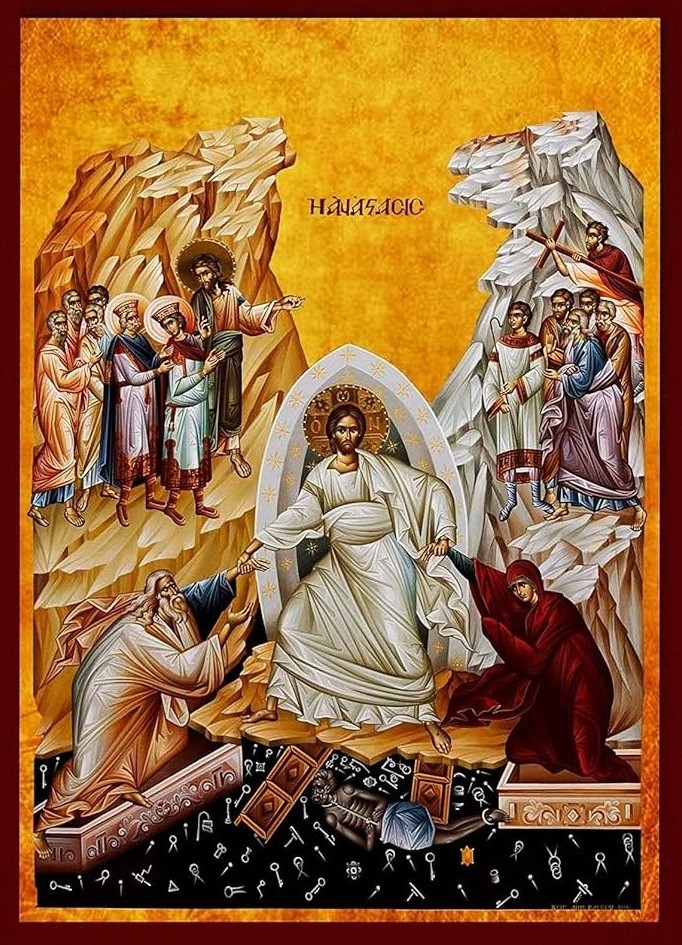
The first-born of God the Father, who then descended into the Virgin’s womb to be born a human child, and subsequently descended into the depths of Hades after His Passion on the Cross, has become the “first-born of the dead” from the tomb! St Paul tells us that this was so that through Christ, God might reconcile all things, whether in heaven or on earth, to Himself (Colossian 1:20).
Thus through weaving a rich tapestry with many scriptures, the hymn connects Christ’s resurrection with God’s Creation of the world, His rescue operation of the Exodus, the fulfilment of His promise and covenant faithfulness, and – most significantly – it connects the Virgin’s womb with the empty tomb.
But wait – there’s one more thing in the hymn that will take your breath away. Christ our God is not only the “first-born of the dead,” He midwifed us, and indeed the whole universe (τῷ κόσμῳ), from the “belly” or womb of Hades (ἐκ κοιλίας ᾅδου). Because of this Son of God and Son of Mary, who turned death into a portal of life, we were born, passing from the perils of death’s dark birth canal into the light of unwaning life. Here I must also marvel at the double-entendre of the English verb, “deliver.” It’s the translation of the Greek word, ἐῤῥύσατο, which means ‘he delivered’ or ‘he rescued.’ Yes, but how marvellous it is that He rescued us by delivering us as newborns into a new world!
Let the image linger in your mind, and you’ll realise how absolutely wonderful a thought it is! I was awe-struck for a brief moment as I discovered with what boldness and imagination the holy hymnographer gave us these words to describe the indescribable. No wonder that the Psalmist and the prophets of old never ceased to be amazed: who is a god like You, O LORD our God! (Pss 35:10; 71:19; 77:13; 89:6, 8; 113:5; Exod 15:11; Micah 7:18)
| About the Author |

Dr Lydia Gore-Jones Senior Lecturer in Biblical Studies (Old Testament) Lydia Gore-Jones is Senior Lecturer in Biblical Studies (Biblical Studies) at St Andrew’s. Her doctoral thesis completed at Macquarie University dealt with two Jewish apocalyptic works as response to the destruction of Jerusalem and the Second Temple by the Romans in AD 70. She has taught subjects related to biblical history and Hebrew language at tertiary level. She had previously worked as radio journalist, translator, and teacher of English as a Second Language... |
Subscribe to our Blog!
Subscribe to our blog written by our Faculty and learn more about your Orthodox Christian faith
Connect With Us
|
|
|
|
Join Our |


.png)
Copyright © 2019 St Andrew's Greek Orthodox Theological College.
All Rights Reserved. | Website Terms & Conditions