- Home
- About us
- Students
- Courses
- Research
- Library
- News & Events
- Gallery
- Contact
- Our Blog
Latest News

Seeing with the Eyes of the Heart:
The Sunday of the Blind Man in the Orthodox Tradition
by Dr Andrew Mellas (Senior Lecturer in Church History and Liturgical Studies)
In the children’s story, ‘The Little Prince’, the fox tells us: “Now here is my secret, very simply: you can only see things clearly with your heart. What is essential is invisible to the eye.” Of course, the author of this tale, Antoine de Saint-Exupéry, is drawing upon a Christian tradition that has long spoken of the heart as the deepest faculty of spiritual perception within the human person. Saint Paul’s prayer that “the eyes of your heart may be enlightened (πεφωτισμένους τοὺς ὀφθαλμοὺς τῆς καρδίας ὑμῶν)”[1] expresses an eternal truth of Orthodox spirituality: true vision is not merely physical sight, nor intellectual comprehension alone, but perceiving the uncreated light through purification, illumination and participation in the divine energies of God. In the liturgical tradition of Byzantium, the opening of the eyes of the heart is both the purpose of Christian life and the gift granted through a personal encounter with Christ, who is revealed as the light of the world that “shines in the darkness.”[2]
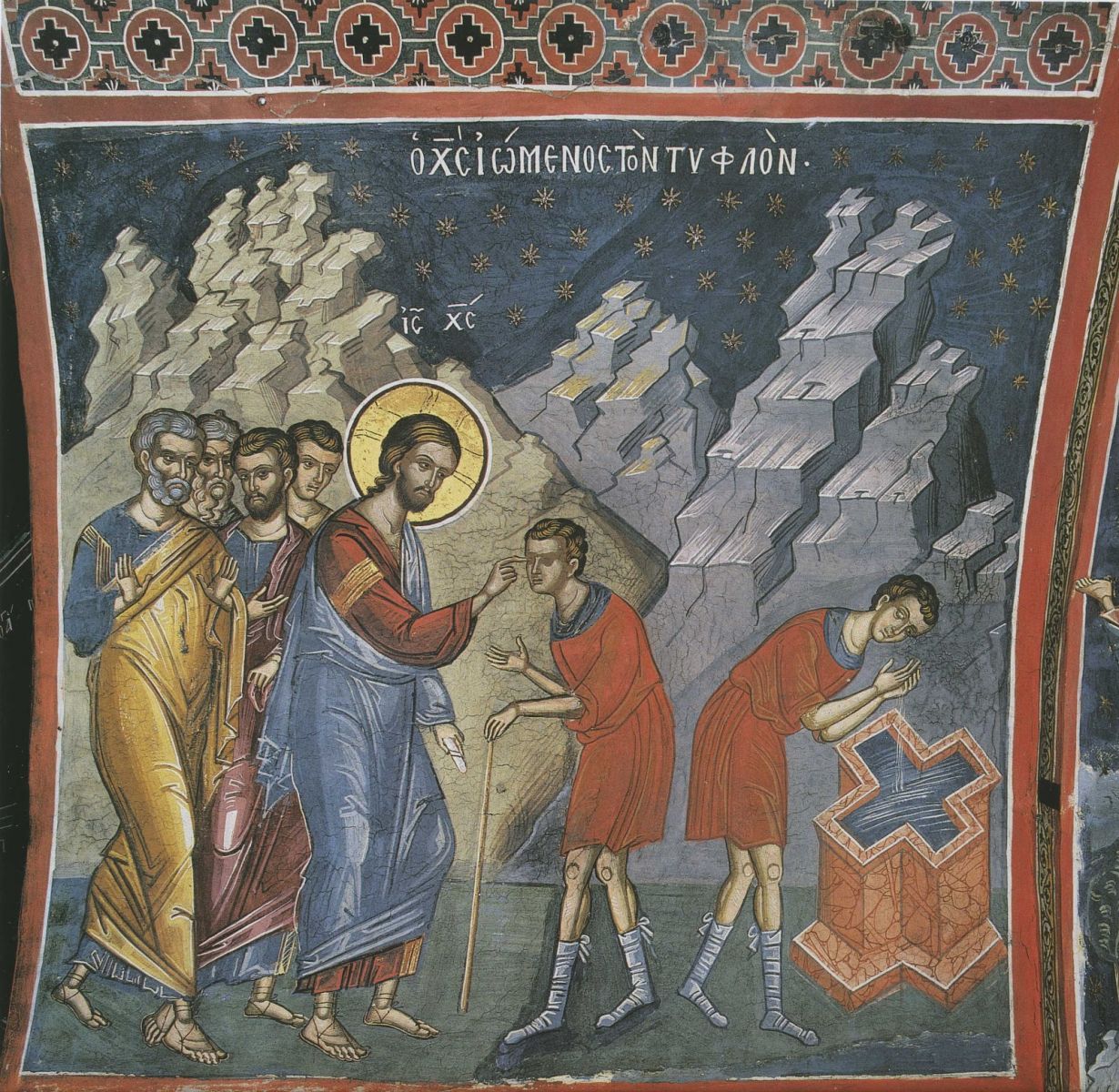
After hearing about this light that invites us to the fullness of life during the celebration of Pascha in the Orthodox Church, we revisit this theme during our journey to Pentecost when we hear the Gospel[3] and hymns assigned for the Sunday of Jesus’ healing of the blind man. This is not simply a miracle of physical restoration; the blind man becomes a universal icon of humanity’s passage from spiritual blindness into divine illumination, from fallenness to salvation. At first, the blind man knows only the man called Jesus. Later, he confesses him to be a prophet. Finally, he worships him as Lord and God. Therefore, the narrative charts an inward journey as well as an outward one. Physical sight becomes the visible sign of a spiritual awakening.
The hymns of the Byzantine liturgical tradition dwell precisely on this transformation and invite the faithful to make it their own:
With the eyes of my soul mutilated I come to you, O Christ, as the man blind from birth, crying to you in repentance: ‘You are the radiant light of those in darkness.’[4]
The blind man in the Gospel of John embodies the estrangement of humankind from holiness. Therefore, Christ’s miraculous healing of his sight gestures towards the very mystery of salvation. The clay placed upon the blind man’s eyes evokes the original creation of Adam from the earth, suggesting that Christ’s healing of the blind man is nothing less than the restoration of our fallen human nature to its ancient dignity and beauty:
Christ our God, spiritual Sun of justice, by your pure touch you enlightened the one who had been deprived of light from his mother’s womb; by shedding your rays on the eyes of our souls, show us to be sons of the day, that we may cry to you with faith, ‘Great and ineffable is your compassion for us. Lover of humankind, glory to you!’[5]
Indeed, this miracle signifies far more than the healing of a blind man; it inaugurates the “new creation”[6] and “a new heaven and a new earth”[7] where humanity is refashioned and illumined by the incarnate Logos.
In stark contrast to this illumination of the blind man, the Gospel presents us with the bumptious intellectual understanding of the Pharisees. Their tragedy is that they claim to possess abundant knowledge, but they are blinded by the false confidence this engenders. Although they are experts in the Law, they fail to perceive its fulfilment in the presence of God standing before them. While the hearts of the Pharisees are hardened, the blind man’s heart has been softened by humility, and so he beholds divine truth through faith and repentance.
Indeed, this approach to experiencing God is at the heart of liturgical life in the Byzantine tradition. The liturgy is less about the systematic acquisition of knowledge and more about how sacred rituals, biblical stories and the symbolic world of Christianity invite the faithful to experience a continuous cycle of existential transformation. Through sacred music and art, incense and gesture, believers are drawn into a mode of seeing beyond the limits of ordinary experience. We move beyond earthly phenomena and behold the world eucharistically, seeing all of creation filled with the unfading light of Pascha.
The plight of the blind man echoes other moments in the Gospel and the liturgical cycle when the apostles and followers of Christ failed to recognise their Teacher. Think of Mary Magdalene weeping at the tomb of Christ after she finds it empty, then seeing a stranger and thinking he is the gardener. Yet when the stranger calls her name, she immediately turns around and realises that it is Christ. There is also the example of Kleopas and Luke on the road to Emmaus, a few days after the death of Christ. As the two disciples are journeying and talking with each other, they come across a stranger. Despite seeing him with their bodily eyes and speaking with him on the road, it is not until they find somewhere to stay for the night and the stranger sits with them at the table—where he takes bread, gives thanks, breaks the bread and gives it to them—that their eyes are opened and they discern that the stranger is Jesus.
Like the disciples, we may think we know Christ, we may believe we have knowledge of the Scriptures, but the mystery of divine power is the paradox of God dying on the cross. Christ comes to us in the form of a servant, and yet in this humility, in his suffering, he manifests the power of God. That is why, through the retelling and reimagining of biblical narratives, the Byzantine liturgical tradition presents to us the Christian life as a continual journey of illumination. Our experience of the liturgy is nothing less than an invitation to behold the divine mystery and to participate in uncreated light; to see a world where “Christ is all and in all.”[8]
[1]Ephesians 1:18.
[2]John 1:5.
[3]John 9.
[4]Kontakion, Sunday of the Blind Man, Pentecostarion.
[5]Idiomelon (vespers), Sunday of the Blind Man, Pentecostarion.
[6]Galatians 6:15.
[7]Revelation 21:1.
[8]Colossians 3:11.
| About the Author |

Dr Andrew Mellas Senior Lecturer in Church History and Liturgical Studies Andrew Mellas is Senior Lecturer in Byzantine History & Liturgical Studies at St Andrew's. In 2018, he completed a Doctor of Philosophy at the University of Sydney on the emotion of compunction in Byzantium. Andrew has published various chapters and articles on the history of Byzantium, liturgics and hymnody in peer-reviewed publications and journals, as well as presenting papers on these subjects at international conferences. He is also a member of the Australian Byzantine Choir... |
Useful links
Subscribe to our Blog!

Subscribe to our blog written by our Faculty and learn more about your Orthodox Christian faith
Connect With Us
|
|
|
|
Join Our |


.png)
Copyright © 2019 St Andrew's Greek Orthodox Theological College.
All Rights Reserved. | Website Terms & Conditions