- Home
- About us
- Students
- Courses
- Research
- Library
- News & Events
- Gallery
- Contact
- Our Blog
Latest News

Sunday of the 318 God-bearing Fathers
of the First Ecumenical Council (325AD):
Their Significance for our Life Today
by Assoc. Professor Philip Kariatlis (Sub-Dean)
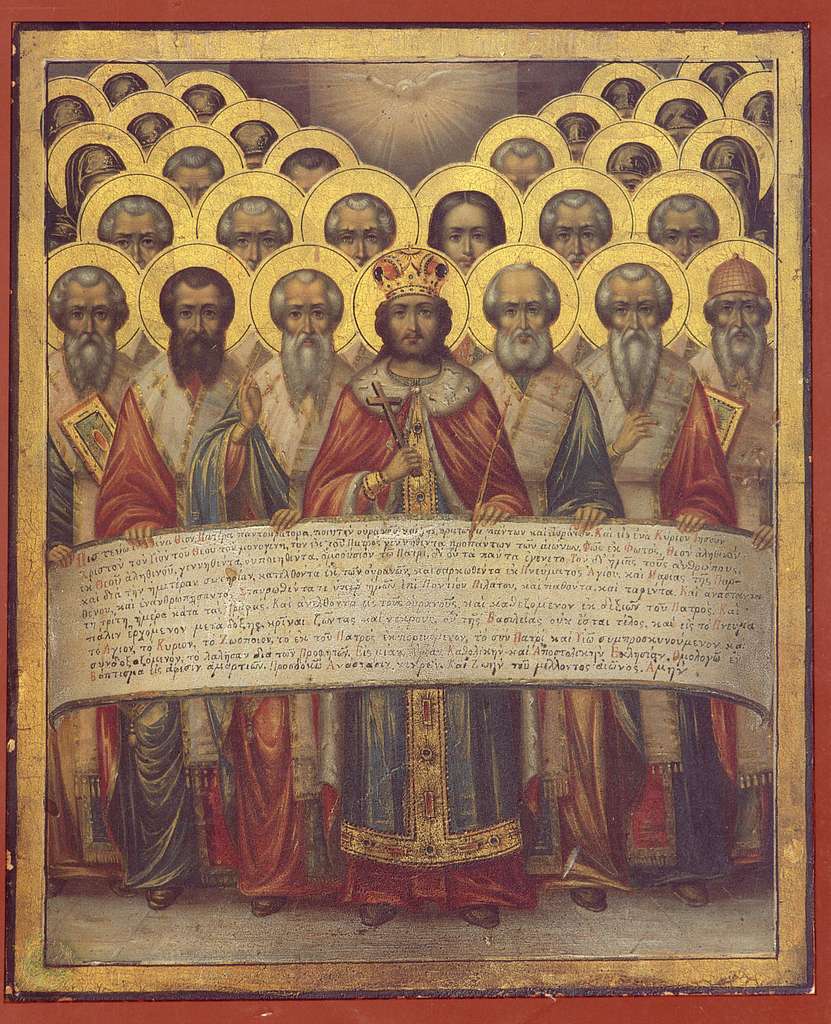
Within the liturgical cycle of the Church, the Sunday immediately following the feast of the Ascension is dedicated to the memory of the three hundred and eighteen Fathers who assembled at Nicaea in 325AD, for what would become known as the First Ecumenical Council. This gathering stands as one of the most significant events in the history of Christianity, for it was there that the Church, under the guidance of the Holy Spirit, articulated with greater precision the apostolic faith in the person and mission of Jesus Christ. Indeed, in the face of doctrinal controversy, this Council issued the first seven articles of the Creed which were subsequently promulgated as a succinct summary, symbol and standard of the Christian faith. To this day this Creed remains a touchstone of orthodoxy’ and an enduring testimony to the Church’s unwavering commitment to proclaiming the truth of the Gospel message of Christ from generation to generation.
It is this Creed which confirmed once and for all the true identity of Jesus Christ as the Second divine Person of the Holy Trinity, namely, the One who, as we read in the Creed, was “begotten of the Father before all ages [τὸνἐκτοῦΠατρὸςγεννηθένταπρὸπάντωντῶναἰώνων]” and was, at the same time, consubstantial with God—“of one essence with the Father [ὁμοούσιοντῷΠατρί]”—namely, a distinct Person or Hypostasis, and, divine with exactly the same divinity as God, his heavenly Father. In this way, both the unity and equality of Christ with the Father, together with His distinct mode of existence within the Godhead were upheld and held together in harmony. It was precisely this presentation of the Faith by these 318 Fathers which safeguarded the Scriptural witness of the saving power of the Son of God.
The significance of the Fathers of the First Ecumenical Council—but more broadly, all the Fathers and saints of the Church—lies in that they remain for us a testimony in thought, word and deed of the true Person of Jesus Christ. In the Orthodox Church, the Fathers are highly revered and honoured because they are the ones who point us to Christ; they bear witness us to a reality beyond—the divine reality of God. They are considered guardians and inspirers of the Christian faith, precisely because they were the ones responsible for protecting the faith from all error, and at the same time, opening the faithful up to the beauty and joy of God's eternal reality, where God is forever glorified, and humanity, together with the entire world, saved.
The fathers of the Church, moreover, are considered to be true pillars and guardians of the Church precisely because they sought to live the message of the Gospel and consequently show us how we too may truly follow Christ. Primarily through their proper reflection of the Scriptures, but also through a life of prayer, through spiritual struggle, self-discipline, and above all, in their daily practice of love – the fathers sought to conform themselves to the radically new way of life witnessed to by Jesus Christ during his earthly life. In so doing, they really came to know, that is, really came into communion with the heart of the Christian faith, that is, God as He is revealed in Jesus Christ and the Holy Spirit. In this way they provide for us insights into that inexpressible beauty of God's eternal blessedness and beatitude. It is precisely this witness to the truth deposited and preserved in the Church through their witness that is cherished, treasured and revered by the Orthodox today.
And so, we can see that the significance of the fathers lies in the fact that not only did they have an immediacy and propinquity with Christ, but they also sought to 'incarnate' – namely give flesh to – their encounter with the living God through their writings. Therefore, being close to the fathers through their works, we, too, can approach and come closer to Christ, since their writings point to Him – that is, they manifest His presence. Accordingly, beyond their philosophical brilliance, beyond their historical achievements, beyond their theological genius, the fathers were and remain our fathers, saints open to the Spirit, men and women of faith, from whom we too can be led by the hand as we seek to be initiated into the 'holy of holies'. Already, we can, therefore, begin to appreciate that the mystery of which they spoke and wrote is not something that should be approached with scepticism and criticism, but rather something that judges and questions us as we seek to approach the living God.
Having gone before us, the fathers of the Church provide for us a proper orientation in the faith, so that we, too, can feel the warmth and security of knowing that we have stable foundations in our life in Christ. Indeed, without them, we could, very easily fall into insecurity and become confused, especially in a world like ours where many people seem to be suffering from, what today is known as the phenomenon of the identity crisis precisely because of the disorientation and uncertainty that exists in our post-modern society. When everything is questioned, and nothing remains sacred, then human persons can, very quickly, feel alone, even though they may be surrounded by many people; they can feel a 'crowded solitude', isolated and lonely amongst the faceless masses because they do not feel that they belong to something greater than them. It is precisely our appeal to the fathers in the Orthodox Church that gives us this sense of fatherly protection and true belonging, solidarity, concord, commonality and unanimity with the Church throughout the ages, going back to the very Church of the apostles, and through them to Christ Himself.
In order to fully appreciate the significance and contribution of the fathers, it is important to realise that they did not consider their writings as ends in themselves, but rather a means and a way – indeed, a way of life leading to God. Their ultimate purpose was to lead the faithful to a vision of God. And so, separated from this salvific context, their theology carries no conviction. Their theology was not concerned with presenting their own personal 'ideas' about God the way some philosophical discipline would by outlining an array of intellectual arguments in order to sway a person towards a certain position. Rather, strongly protesting against the empty use of philosophical dialectics, their theology was essentially a vision of faith as revealed to them by God Himself. It is for this reason that theology [θεολογία] for them was but the first step leading to the vision or contemplation of God [θεοπτία] and ultimately deification [θέωσις]. So, we read the fathers in order to undergo the 'good change' [καλή άλλοίωσις] towards God, our heavenly Father.
The stance and attitude of the faithful today, therefore, should be one which strives to enter into the world of the fathers in order to discern the spirit in which they wrote. Far from simply singling out and quoting certain isolated texts out of context, we must seek to follow in the footsteps of the fathers in order to recover their mind and theological way of thinking. In this regard, Father Georges Florovsky wrote: "'To follow' the fathers does not mean just 'to quote' them. 'To follow' the fathers means to acquire their 'mind', their phronema [namely their spirit or mind-set]."[1] This can only be achieved when we entrust ourselves to them, in the same way that children entrust themselves to their biological parents. We can think of it in the following way: we can only be success-ful – namely full of success – in the Christian life only to the degree that we are in success-ion with the fathers. In so doing, we will have been assured of having become heirs to a genuine and priceless inheritance given by God; an unbelievable and undeserved privilege, but at the same time, duty to transmit this unimpaired to future generations.
I end with a hymn that is sung in our Church on the Sunday of the Fathers of the First Ecumenical Council, which beautifully sums us the importance of the Fathers. The hymn in question stresses that the fathers are precisely those who have maintained the veracity and identity of the apostolic faith and have handed it down integrally throughout the generations to the present day. Moreover, according to this hymn, the fathers of the Church are those who, in every age, authentically witness to the abiding presence of the Holy Spirit in the 'body of Christ', that is, the Church since they are in the continual company of the Lord. This is why the fathers are given so much honour and chanted so panegyrically in our Church twice a year.
The choir of the Holy Fathers
Came together from the ends of the world;
They taught one essence and nature of the Father, Son and Holy Spirit
And they handed over the mystery of theology in all its integrity
And it is for this reason that we praise them in faith saying:
"O divine co-mingling, o God-bearing soldiers of the company of the Lord,
O ever-bright and many stars of the spiritual world
O enthroned towers of the mystical Zion
O myrrh-bearing blossoms of paradise
O all-golden mouthed saints of the Word
You are the pride of Nicaea; the joy of the world,
Incessantly intercede for our souls."
For this reason, with the fathers, we can never feel as though we have been abandoned or left orphaned; on the contrary we are as precious links in an unbreakable chain taken back, by the fathers, to the times of the apostles! Therefore, only praise and thanksgiving are befitting to God, for His gift, to the Church, of the choir of the fathers, allowing us therefore, in an authentic way, to celebrate, the holy and glorious Name of God in a manner befitting God!
[1]Fr Georges Florovsky, Bible Church Tradition: An Eastern Orthodox View (Norland: Belmont, 1972), 108.
| About the Author |
Associate Professor Philip Kariatlis Sub-Dean of St Andrew's Greek Orthodox Theological College Associate Professor Philip Kariatlis is Academic Director and Associate Professor in Theology at St Andrew's. After taking an undergraduate degree in Theology from St Andrew's, he graduated from the University of Sydney with a degree in Arts, majoring in Modern Greek. He received a Master of Theology and a doctorate from the Sydney College of Divinity, where he studied under Professor Gerard Kelly. His doctorate was in the area of ecclesiology where he examined the notion of koinonia ... |
Useful links
Subscribe to our Blog!
Subscribe to our blog written by our Faculty and learn more about your Orthodox Christian faith
Connect With Us
|
|
|
|
Join Our |


.png)
Copyright © 2019 St Andrew's Greek Orthodox Theological College.
All Rights Reserved. | Website Terms & Conditions