- Home
- About us
- Students
- Courses
- Research
- Library
- News & Events
- Gallery
- Contact
- Our Blog
Latest News

When Darkness Meets the Light of Christ
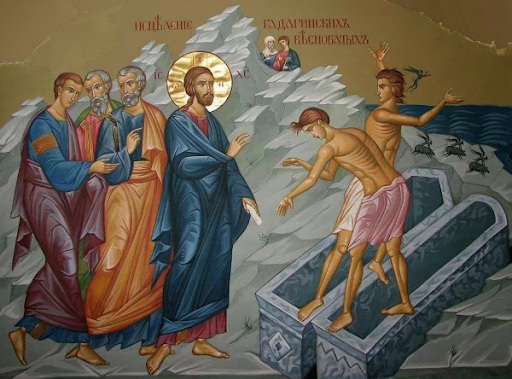
The Healing of the Gerasene Demoniacs
Fifth Sunday of Matthew - Reflection
by Assoc. Professor Philip Kariatlis (Sub-Dean)
When our Lord Jesus Christ—the pre-eternal Word of God, “through whom all things were made,” as we proclaim in the Creed—walked among humanity, He spoke in a manner at once simple and profound, in a way that invited every human heart to draw near to Him and be transformed. Through His parables, He revealed the eternal mysteries of God, seeking to awaken the human soul to the wonder of divine love, to guide it gently back to its true orientation, and to unveil, gradually and tenderly, to those able to receive it, who He truly was. His words were never lofty abstractions but living seeds—cast into the soil of ordinary lives—that they might take root, blossom, and bear fruit in the transformation of the human heart. Thus, He comforted the sorrowful, fed the hungry, gave water to the thirsty, healed the sick, restored sight to the blind, and gave hearing to the deaf.
In the Gospel reading about the healing of the two Gadarene men (Matthew 8:28-9:1) we behold yet another manifestation of that same life-giving compassion: Christ’s encounter with the two demoniacs who had long been fiercely tormented by a multitude of unclean spirits. Once more, He reveals Himself as the true Physician of our souls and bodies, the One who underwent much suffering for our sake (cf. 2Cor 1:5), the Lover of humankind, who desires nothing other than to heal the wounded human condition and to restore to creation the lost joy, grace, and peace that comes with encountering Christ. In these tragic figures, Christ sees not vessels of impurity but beloved images of God awaiting restoration. Our Lord’s infinite compassion stoops to the very depths of human misery, entering the realm of brokenness so that even there in the darkness of evil, the resplendent and unfading light of God might dawn and the dignity of the human person be renewed.
St Matthew paints the scene with striking vividness. The two men whom Christ encounters are stripped of every trace of dignity, driven by demonic powers into desolate places—among tombs, along barren shores, far from home and human fellowship. Their lives were a haunting image of isolation from society and disintegration: two souls exiled and deprived of rest, without community, wandering among the dead. Yet into this darkness Christ steps silently, not with condemnation but with compassion; not with force, but with authority. And at His word, the chaos subsides. In the Gospel according to St Luke, we learn that the possessed men are now found “clothed and in his right mind,” seated at the feet of the One who alone can restore peace to the human heart.
From this account, two essential lessons emerge for our contemplation. The first concerns the tragic state of the human condition when separated from God. The demoniac of the Gospel mirrors, in a spiritual sense, every soul enslaved by passions and addictions—those tyrannies of the heart that wield greater power over us than we do over them. Whenever we distance ourselves from God, we turn from the very source of joy and peace; we become restless, fragmented, and estranged from our true being. Pride, greed, anger, envy, and self-love gradually imprison the soul, and the fruits of such estrangement inevitably appear: bitterness, resentment, broken families and relations, and hearts that have forgotten how to forgive or to love. This is the slow tragedy of sin: a life adrift in loneliness and inner desolation, a heart wandering among the tombs of its own making. Yet when we welcome our loving Lord once more into the centre of our lives, the darkness begins to lift. His presence dispels the gloom and restores to the soul the light of hope. As we strive, with His grace, to uproot the thorns that have taken root within us, His healing gifts—peace, joy, and renewal—begin to permeate every aspect of our being.
The second lesson arises from the response of the townspeople, the Gadarenes. Having witnessed the miracle, they are not moved to faith but to fear. Instead of rejoicing in the liberation of their neighbour, they beg Christ to leave their region. The healing of these two tormented souls had unsettled their comfort; their swine—the symbol of profit and indulgence—had perished, and with them their sense of security. Confronted by divine power, they chose the familiar safety of their possessions over the transforming presence of the Saviour. In their fear of losing what was temporal, they forfeited what was eternal. Before them stood the Lord of life, and they asked Him to depart.
This scene, striking in its simplicity, poses a question as profound now as it was then: do we truly desire Christ to dwell within our lives, or do we, like the Gadarenes, ask Him to withdraw when His presence unsettles the fragile order of our convenience? Do we genuinely long for the life in Christ, or do we cling to the fleeting certainties of our own making—those illusions of control that promise comfort but leave the heart barren? So often, the divine invitation comes quietly, in moments that disturb our complacency, challenging the idols we have built from habit, ambition, or fear. Yet Christ never forces His way in; He waits for the willing heart, for the soul ready to exchange its shallow securities for the freedom of His love. The Gospel compels us to respond—not merely with words or passing emotion, but with the re-orientation of our whole being, turning again toward the One whose presence alone can make us whole and whose Love can give us true permanence and meaning.
Elsewhere the Lord Himself gives the measure of discipleship: “Seek first the Kingdom of God and His righteousness, and all these things shall be added to you” (Matthew 6:33). When Christ becomes the axis around which our thoughts, desires, and actions revolve, everything else in life finds its rightful order. How often we scatter our strength in pursuit of comfort, success, and security, forgetting that the heart can know no true peace until it rests in God. To seek Christ above all else is not to reject the world, but to behold it transfigured in His light—to discover within the ordinary the radiance of divine purpose.
Let us, then, each day strive to enthrone Him anew at the centre of our lives: in our decisions, in our relationships, in our prayer, and in our work. For when Christ dwells within us, all that is disordered is restored to harmony; all that is fragmented is gathered into wholeness; and life itself becomes, once again, a reflection of the Kingdom that has no end.
| About the Author |

Associate Professor Philip Kariatlis Sub-Dean of St Andrew's Greek Orthodox Theological College Associate Professor Philip Kariatlis is Academic Director and Associate Professor in Theology at St Andrew's. After taking an undergraduate degree in Theology from St Andrew's, he graduated from the University of Sydney with a degree in Arts, majoring in Modern Greek. He received a Master of Theology and a doctorate from the Sydney College of Divinity, where he studied under Professor Gerard Kelly. His doctorate was in the area of ecclesiology where he examined the notion of koinonia ... |
Useful links
Subscribe to our Blog!

Subscribe to our blog written by our Faculty and learn more about your Orthodox Christian faith
Connect With Us
|
|
|
|
Join Our |


.png)
Copyright © 2019 St Andrew's Greek Orthodox Theological College.
All Rights Reserved. | Website Terms & Conditions